
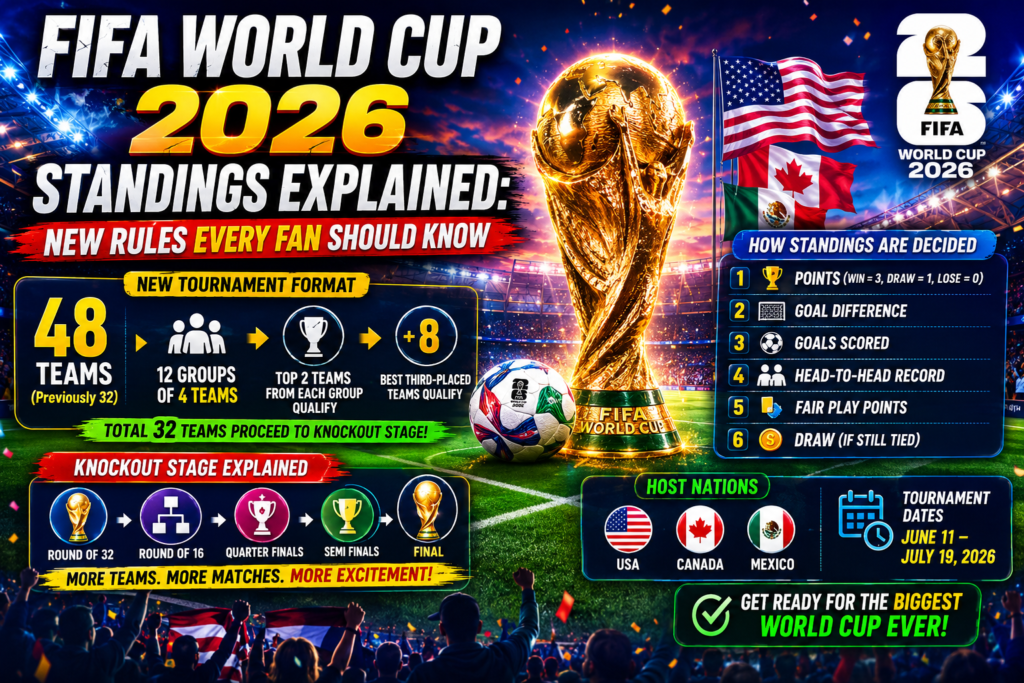
The FIFA World Cup 2026 is unlike any tournament football fans have experienced before. For the first time in history, 48 national teams are competing for football’s biggest prize, creating a completely new tournament format. While this expansion gives more countries the opportunity to participate, it also introduces new standings, qualification rules, and tiebreakers that every fan should understand.
If you’ve been wondering why some third-placed teams are still celebrating while others are eliminated, or how the new standings work, this guide explains everything in simple terms.
Why Are the Standings Different in FIFA World Cup 2026?
Previous FIFA World Cups featured 32 teams divided into eight groups.
The 2026 edition has expanded dramatically:
- 48 participating nations
- 12 groups (Group A to Group L)
- 4 teams in each group
- Every team plays three group-stage matches
This larger format creates more matches, more excitement, and more opportunities for emerging football nations to compete on the world stage. It also means the standings are more complex than ever before.
How Group Standings Work
The basic points system remains familiar:
- Win = 3 points
- Draw = 1 point
- Loss = 0 points
Each team plays:
- Match 1
- Match 2
- Match 3
After all three games, teams are ranked according to their total points.
A typical standings table includes:
- Matches Played (P)
- Wins (W)
- Draws (D)
- Losses (L)
- Goals For (GF)
- Goals Against (GA)
- Goal Difference (GD)
- Points (Pts)
The higher your points total, the higher you finish in the group.
Who Qualifies for the Knockout Stage?
This is the biggest change in the new World Cup.
Instead of only the top two teams advancing, qualification now works like this:
- Top two teams from each of the 12 groups qualify automatically.
- The eight best third-placed teams also qualify.
That means:
- 24 automatic qualifiers
- 8 best third-place teams
Together, these 32 teams move into the newly introduced Round of 32 before the traditional Round of 16.
Why Third Place Still Matters
In previous World Cups, finishing third meant going home.
Not anymore.
A team finishing third with four points—or even three points in some situations—may still qualify depending on how other third-placed teams perform.
This means every goal matters until the final whistle of the group stage.
Fans now have to keep an eye not only on their own group but also on the standings across all 12 groups.
How the Best Third-Placed Teams Are Ranked
When comparing third-place finishers from different groups, FIFA follows a ranking system.
The order is:
- Total points
- Goal difference
- Goals scored
- Fair Play record (disciplinary points)
- Drawing of lots if still tied
Because of these rules, even scoring one extra goal in the final group match can be the difference between advancing and elimination.
Understanding Goal Difference
Goal difference is calculated by:
Goals Scored – Goals Conceded
Example:
Team A
- Goals scored: 6
- Goals conceded: 3
- Goal Difference: +3
Team B
- Goals scored: 5
- Goals conceded: 4
- Goal Difference: +1
If both teams finish with the same number of points, Team A ranks higher because of its better goal difference.
Why Every Goal Counts
Imagine this situation:
Team X wins:
- 2–0
- Loses 1–2
- Draws 1–1
Total:
- 4 points
- Goal Difference: 0
Another team wins:
- 1–0
- Loses 0–3
- Draws 1–1
Also:
- 4 points
- Goal Difference: -2
Even though both teams earned the same points, the first team finishes above the second because of superior goal difference.
What Happens If Teams Finish Level?
Inside each group, FIFA uses several tiebreakers.
These include:
- Points
- Goal difference
- Goals scored
- Head-to-head results
- Head-to-head goal difference
- Head-to-head goals scored
- Fair Play points
- Drawing of lots (if required)
This system ensures teams are separated fairly even when they have identical records.
The New Round of 32
Another historic addition is the Round of 32.
Instead of moving directly into the Round of 16, qualified teams now play one extra knockout match.
The path is:
- Group Stage
- Round of 32
- Round of 16
- Quarter-finals
- Semi-finals
- Third-place Playoff
- Final
As a result, the eventual World Cup champion must now win eight matches instead of seven to lift the trophy.
More Drama Until the Final Group Match
One of the biggest advantages of the expanded format is increased excitement.
Previously, some teams were eliminated after only two matches.
Now, even teams sitting in third place remain hopeful of qualification.
This creates:
- More meaningful final group matches
- Greater competition across all groups
- Increased opportunities for surprise teams
- More scenarios where goal difference becomes crucial
Fans now follow not only their own group but also the live standings of every third-placed team.
Common Mistakes Fans Make
Many supporters are still adjusting to the new system.
Some common misconceptions include:
- Believing third place means automatic elimination
- Ignoring goal difference
- Forgetting that goals scored can separate tied teams
- Assuming only group winners advance
Understanding the new format makes watching the tournament much more enjoyable.
Why FIFA Introduced These Changes
The expanded tournament aims to:
- Include more nations from around the world
- Increase global participation
- Give smaller football countries a realistic chance to compete
- Deliver more matches for fans
- Create a more competitive and inclusive World Cup
While opinions differ on the expansion, there’s no doubt it has added new layers of strategy and suspense to the group stage.
Final Thoughts
The FIFA World Cup 2026 has transformed how fans follow the group stage. With 48 teams, 12 groups, and a new Round of 32, understanding the standings is more important than ever. Every point, every goal, and every disciplinary record can influence who advances.
Whether your favorite team finishes first or battles for one of the coveted third-place qualification spots, staying informed about the new rules makes every match more exciting. As the tournament unfolds, the updated standings will continue to shift, proving that in this expanded World Cup, every moment truly counts.
