Introduction
Walk into a classroom today and the furniture might look the same — rows of desks, a whiteboard at the front, students hunched over notebooks. But beneath that familiar surface, something fundamental is shifting. The way lessons are designed, delivered, and assessed is changing at a pace that would have seemed implausible just a decade ago. Artificial intelligence has entered the school building, and its influence is spreading from kindergarten reading groups to university lecture halls.
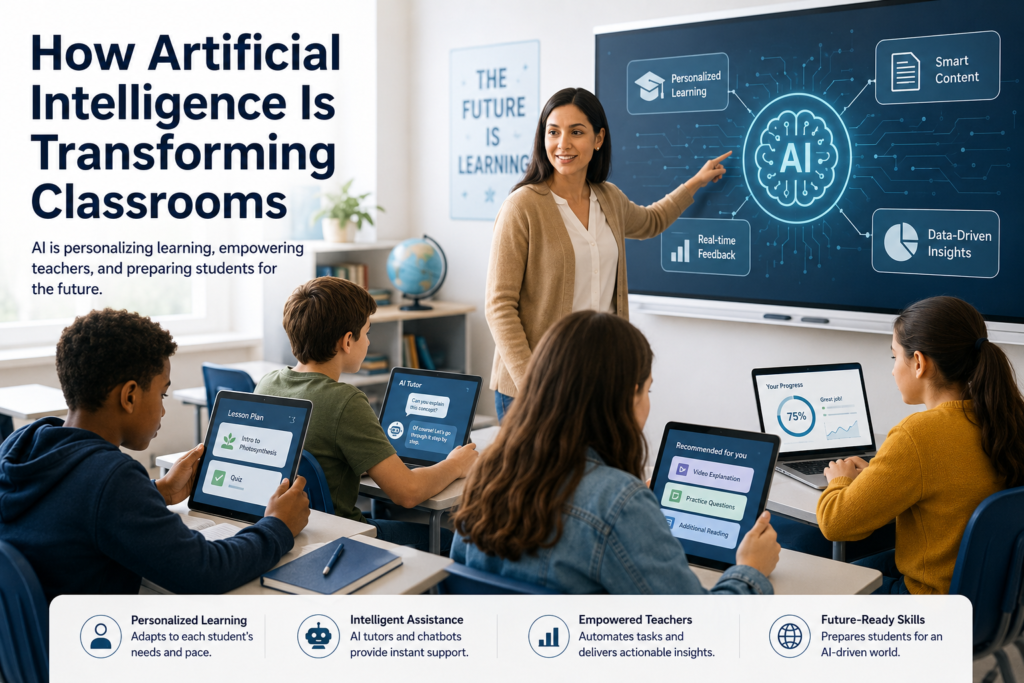
This is not a story about robots replacing teachers or students bypassing learning entirely. The reality is more nuanced, and in many ways more interesting. Artificial intelligence is functioning less like a disruptor and more like a quiet collaborator — one that handles repetitive tasks, surfaces patterns in student performance, and opens up possibilities for personalized instruction that a single teacher managing thirty students could never achieve alone.
The Problem AI Is Trying to Solve
To understand why educators are paying attention to artificial intelligence, it helps to first understand the structural problem that has plagued formal schooling for over a century.
Traditional classroom instruction is designed around the average student. A teacher plans a lesson, delivers it to the group, and moves on when most students seem to grasp the material. The student who understood everything five minutes in sits bored. The student who is still confused falls further behind. Neither gets what they actually need, because the model was never built to serve individuals — it was built to serve a population.
This is not a failure of teachers. A single educator cannot realistically track every student’s comprehension in real time, adjust instruction on the fly for thirty different learning paces, and provide personalized feedback on every assignment — not while also managing classroom dynamics, communicating with parents, completing administrative work, and planning the next week’s curriculum.
Artificial intelligence, at its most useful in educational settings, addresses this mismatch directly. It can process enormous amounts of student data continuously, identify where each learner is struggling, and adjust what that learner sees next without requiring the teacher to intervene at every step.
Personalized Learning at Scale
The most significant application of artificial intelligence in education is adaptive learning — systems that modify the difficulty, pacing, and format of content based on how a student is performing in real time.
When a student works through a math problem set on an adaptive platform, the system is not simply marking answers right or wrong. It is tracking how long the student paused before answering, whether they skipped a question and returned, which specific type of problem caused errors, and whether those errors follow a recognizable pattern. A student who consistently struggles with fraction division but handles decimal operations well will receive a different sequence of exercises than a student whose errors suggest a more foundational gap in understanding place value.
This kind of differentiation has always been the aspiration of good teaching. Skilled educators have always tried to meet students where they are. Artificial intelligence makes it possible to do this systematically, for every student, every day, without burning out the teacher.
Language learning platforms have demonstrated some of the clearest results in this area. Systems that track vocabulary retention and schedule review sessions based on predicted forgetting curves have shown measurable improvements in retention compared to fixed-schedule study methods. Students spend less time reviewing material they already know and more time reinforcing concepts that are slipping away.
Reading instruction has seen similar developments. Tools that analyze oral reading fluency by listening to a student read aloud can identify whether errors involve decoding, phrasing, or comprehension — distinctions that matter enormously for deciding how to help. A student who stumbles on unfamiliar words needs different support than a student who reads every word correctly but cannot explain what the passage meant.
Intelligent Tutoring Systems
Beyond adaptive content delivery, a more sophisticated category of educational technology uses artificial intelligence to simulate the dialogue of one-on-one tutoring.
Intelligent tutoring systems do not simply present information and check answers. They engage students in a back-and-forth process more closely resembling a conversation with a knowledgeable guide. When a student makes an error, the system does not just flag it as wrong. It asks a follow-up question designed to probe whether the error was a careless mistake or a conceptual misunderstanding. It offers hints calibrated to give the student just enough scaffolding to move forward without giving the answer away.
Research on these systems, some of it dating back to the 1980s but growing substantially in recent years, has consistently found that students using well-designed intelligent tutors learn at rates significantly faster than students in conventional classroom instruction — in some studies, approaching the learning gains associated with private human tutoring. The mechanisms behind this appear to be related to immediate feedback, frequent low-stakes practice, and the system’s ability to keep students working within what educators call the zone of proximal development — the productive space between what a student can already do and what remains genuinely out of reach.
These systems have historically been expensive to build and limited in scope, covering narrow subject areas where correct and incorrect answers are unambiguous. Advances in language modeling have begun to expand that scope, enabling systems capable of engaging with more open-ended questions, essay responses, and reasoning tasks that do not have a single correct answer.
Freeing Teachers from Administrative Load
One of the less glamorous but practically significant ways artificial intelligence is affecting classrooms involves the time teachers spend on tasks that have nothing to do with teaching.
Grading is the most obvious example. A high school English teacher with five classes of thirty students each cannot provide detailed, individualized feedback on every draft of every essay. The arithmetic simply does not work. What typically happens is that shorter assignments get quick marks, longer assignments get general comments, and the granular, specific feedback that most improves student writing goes unwritten because there is no time.
Artificial intelligence tools that analyze written work can provide immediate, specific feedback on elements including sentence variety, argument structure, evidence use, transitions between ideas, and mechanical correctness. This is not a replacement for a teacher’s engagement with a student’s ideas — the machine cannot evaluate whether an argument is genuinely insightful or whether a student has synthesized sources in a sophisticated way. But it can handle the mechanical layer, freeing the teacher’s attention for the kind of feedback that requires human judgment.
Similar automation is appearing in other parts of the teacher’s workload. Scheduling systems that analyze attendance patterns, assignment completion rates, and assessment scores can flag students who are showing early signs of disengagement before those signs become visible to the naked eye. A student who has been submitting work late, declining in quiz scores, and missing class occasionally may be heading toward failure — and a system that surfaces that pattern at week four of a semester gives a teacher the opportunity to intervene while there is still time.
Administrative tasks including progress report generation, parent communication drafts, and lesson plan templates represent additional areas where automation is reducing the friction of teaching work, leaving more cognitive energy for the interactions that matter most.
Accessibility and Inclusion
Artificial intelligence has opened doors for students who have historically been underserved by standard classroom formats.
Students with visual impairments benefit from tools that convert written text to speech with greater fluency and naturalness than earlier text-to-speech systems, and that can describe images, charts, and diagrams in words. Students with dyslexia or reading difficulties can access content at their comprehension level while receiving reading support that does not require pulling them out of class. Students who are learning in a language that is not their first can receive real-time translation and vocabulary support without waiting for a bilingual aide.
Speech recognition technology, significantly improved through machine learning, has made voice-based interaction a viable mode of engagement for students with motor impairments who find typing or writing difficult. Students who have traditionally been excluded from full participation in written academic work can now produce written output through speech with greater accuracy than earlier generations of the technology allowed.
Captioning systems that automatically transcribe spoken audio have made video content and live lectures more accessible to students with hearing impairments, as well as to students in noisy environments, students who process language more effectively through reading, and students whose first language differs from the language of instruction.
The cumulative effect of these tools is a modest but real widening of the circle of students who can access grade-level content and participate meaningfully in academic settings.
Early Childhood and Literacy Development
In the earliest years of formal schooling, artificial intelligence is influencing how foundational literacy skills are built.
Reading is perhaps the area where the stakes are highest. A student who does not become a proficient reader by the end of third grade faces compounding disadvantages throughout the rest of schooling, because reading transitions from a learned skill to the primary vehicle through which all other learning happens. Identifying reading difficulties early — before a child has spent years falling behind — is therefore one of the highest-value interventions available to educators.
Artificial intelligence tools designed for early literacy can analyze a child’s performance on phonological awareness tasks, letter recognition, and early decoding with enough granularity to identify children at risk for reading difficulties well before those difficulties are obvious in classroom performance. This earlier identification enables earlier intervention, which research consistently shows produces better outcomes than waiting until a child is noticeably struggling.
Some tools in this space allow young children to interact with digital reading companions that respond to their spoken attempts to read, affirm correct sounds, and gently correct errors — providing the kind of patient, repetitive practice that early reading requires without taxing teacher time or making a child feel self-conscious about making mistakes in front of peers.
Higher Education and Professional Training
In universities and professional training environments, artificial intelligence is reshaping how knowledge is assessed and how expertise is developed.
Simulation-based learning, long used in fields like aviation and medicine, has become more sophisticated and more widely available as the computational cost of realistic simulations has fallen. Medical students can practice diagnostic reasoning with simulated patients who present symptoms, respond to questions, and deteriorate or improve based on treatment decisions — gaining experience that would otherwise require either real patients or expensive standardized patient programs. Law students can analyze simulated case files. Engineering students can run virtual experiments.
In research settings, artificial intelligence tools are changing how graduate students engage with academic literature. Systems that can summarize large volumes of research, identify methodological patterns across studies, and flag relevant work that a researcher might not have encountered through traditional search are compressing the time required to develop genuine expertise in a field.
Assessment in higher education is also evolving. In fields with clear right-and-wrong answers — programming, mathematics, formal logic, language translation — automated assessment can provide instant feedback on student work at a scale and speed that human grading cannot match. In fields requiring judgment, the role of automation is more limited but still present, with tools that handle initial screening or flag specific elements for human review.
The Ethical Terrain
No account of artificial intelligence in education would be complete without acknowledging the genuine concerns that accompany its growth.
Data privacy is the most frequently raised issue, and with good reason. Adaptive learning systems function by collecting detailed behavioral data — every click, every pause, every error, every revision. This data is educationally valuable precisely because it is granular and continuous. But it also represents an unusually intimate portrait of how a child thinks, struggles, and develops. The governance of that data, who has access to it, how long it is retained, and what uses are permissible, remains inconsistently addressed across jurisdictions and institutions.
Algorithmic bias is a related concern. Any system trained on historical data will reflect the patterns in that data, including patterns that encode historical inequities. A system trained primarily on data from well-resourced schools may perform less reliably for students from different educational backgrounds. A reading assessment trained predominantly on native English speakers may misread the error patterns of English language learners. These failures are not hypothetical — they have appeared in deployed systems, and they disproportionately affect students who were already disadvantaged.
The question of what happens to the teacher-student relationship also deserves serious consideration. The relational dimension of education — the mentor who notices when a student is struggling with something beyond the curriculum, the teacher whose encouragement shapes a student’s belief in their own capacity — is not easily captured in data and is not something any current system can replicate. There is a real risk that as efficiency gains from technology compress the time teachers spend on tasks that can be automated, schools prioritize the measurable over the irreplaceable.
Academic integrity presents another challenge. The same tools that can help a student think through a problem can be used to produce work that misrepresents the student’s own understanding. The long-term response to this challenge likely involves rethinking what kinds of assessment genuinely require that work be produced without assistance, rather than simply intensifying surveillance — a shift that is culturally significant but educationally overdue.
What Teachers Say
Educators who have worked with artificial intelligence tools in their classrooms tend to describe their experience in terms that differ from both the enthusiastic vendor narratives and the apocalyptic fears that dominate public discourse.
Many report that the most valuable change is the recovery of time and attention. When a tool handles initial feedback on a writing draft or flags which students are likely to struggle on an upcoming assessment, teachers can redirect that time toward the conversations, relationships, and creative instructional decisions that no technology is close to handling well. The experience is less of being replaced and more of having an unusually capable assistant for the tedious parts of the job.
Teachers also report frustration with implementation — with tools that require significant training to use effectively, with platforms that don’t integrate with other systems, with data that is collected but not presented in ways that are useful during a forty-minute class period. The gap between what technology promises and what it delivers in actual classroom conditions is frequently significant.
The most common request from teachers is not for more powerful tools but for better professional development — for time and support to understand what the tools actually do, to evaluate their claims critically, and to integrate them thoughtfully rather than adopting them because an administrator mandated it or a vendor demonstrated something impressive.
Looking Ahead
The pace of development in educational technology has accelerated substantially in recent years, and several directions seem likely to shape the near future.
Multimodal interaction — systems that can process and respond to speech, handwriting, drawing, and gesture, rather than requiring everything to be typed — will make digital tools more accessible to young children and to learners who find text-based interfaces limiting. The ability to have a natural spoken conversation with an educational system, rather than clicking through structured menus, changes who can benefit from the technology.
Greater integration between tools that currently operate in isolation will enable a more coherent picture of each student’s learning across subjects and over time. The reading tool, the math platform, the writing assistant, and the student information system currently generate separate data streams that rarely communicate. As integration improves, educators will be able to see patterns that span subjects and identify needs that no single-subject tool would surface.
The question of how to prepare teachers for this environment — not just to use specific tools, but to think critically about what educational technology does and does not do well — is one that teacher education programs are only beginning to seriously engage.
Conclusion
Artificial intelligence is not going to fix education. The challenges that matter most in schooling — poverty, inequality, the social conditions that make learning difficult for so many children, the chronic underfunding of schools that serve the students who need the most support — are not technological problems, and they do not have technological solutions.
What artificial intelligence can do, when implemented thoughtfully and with honest attention to its limitations, is give teachers better information, reduce the time they spend on tasks that don’t require human judgment, and expand the range of students who can access content designed for their actual level rather than the level of the average student.
The classroom is not going away. The relationship between a skilled teacher and a curious student is not going away. What is changing is the set of tools available to support that relationship — and how those tools are used will depend, as it always has, less on the technology itself than on the wisdom, values, and priorities of the people using it.
