
Introduction
Most students study the wrong way — not because they are lazy or unintelligent, but because the techniques that feel most productive often are not. Rereading a chapter feels thorough. Highlighting feels active. Cramming the night before an exam feels efficient. Decades of cognitive science research tells a different story: these methods produce a shallow, fragile form of learning that fades quickly and transfers poorly to new situations.
The gap between perceived and actual effectiveness is one of the most well-documented findings in educational psychology. A landmark review published in Psychological Science in the Public Interest in 2013, led by John Dunlosky and colleagues at Kent State University, systematically evaluated ten of the most commonly used study strategies. The results were striking. Techniques that students rely on most heavily — rereading, highlighting, summarizing — received the lowest ratings for effectiveness. Techniques that students rarely use — retrieval practice, distributed practice — received the highest.
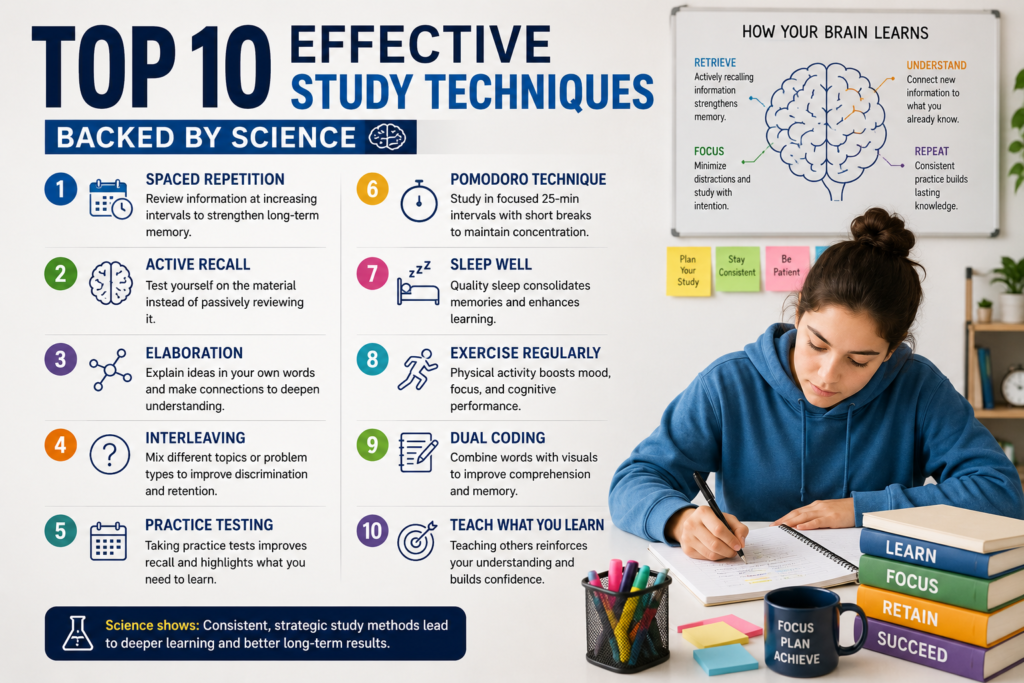
This article examines ten study techniques with strong scientific support. The emphasis throughout is not on what feels effective, but on what the evidence actually shows produces durable, transferable learning.
1. Retrieval Practice (The Testing Effect)
If there is one finding from cognitive science that every student should know, it is this: the act of retrieving information from memory is one of the most powerful ways to strengthen that memory.
This phenomenon — known as the testing effect or retrieval practice effect — has been replicated in hundreds of studies across different age groups, subjects, and formats. The core finding is consistent: being tested on material, or testing yourself on it, produces significantly better long-term retention than spending the same amount of time rereading or reviewing.
The mechanism appears to involve the effort of retrieval itself. When you struggle to pull information from memory, your brain does not just locate that memory — it strengthens the neural pathways that lead to it, making future retrieval easier and more reliable. This is why testing is not merely a way of measuring learning; it is itself a form of learning.
Practical application: After reading a section of material, close the book and write down everything you can remember. Use flashcards — but use them actively, by genuinely attempting to recall the answer before flipping. Take practice tests without looking at your notes first. Generate questions as you read, then answer them later without reference to the text.
The key is that retrieval must be genuine — you have to actually try to remember before checking. Looking at a flashcard and confirming that you recognize the answer is not the same as retrieving it. Recognition and recall are different cognitive processes, and only genuine recall produces the testing effect.
2. Spaced Practice (Distributed Learning)
Spacing out study sessions over time produces dramatically better long-term retention than concentrating the same total study time into a single session. This finding — one of the most robust in all of memory research — is known as the spacing effect, and it has been documented in studies dating back to Hermann Ebbinghaus in the 1880s.
The reason spacing works is connected to what Ebbinghaus also identified: the forgetting curve. Memory decays over time, and the rate of decay is steepest immediately after learning. When you study something and then return to it after a period of forgetting has begun, the effort of relearning strengthens the memory more than if you had reviewed it before any forgetting occurred. Spacing practice to intercept the forgetting curve — returning to material just as it is beginning to fade — produces optimal retention.
This is the opposite of cramming. Cramming exploits the short-term workings of memory to produce performance that peaks on the day of the exam and then collapses. Spaced practice produces slower initial learning that is far more durable over time.
Practical application: Distribute study sessions across days and weeks rather than hours. Review material from previous weeks alongside new material. Use a spaced repetition system — flashcard applications like Anki use algorithms to schedule reviews at optimal intervals, surfacing material just as it is about to be forgotten. Plan your study calendar backward from the exam date, building in multiple spaced sessions rather than one long review.
3. Interleaving
Most students study one topic until they feel they have mastered it, then move to the next. This approach — called blocked practice — feels logical and produces quick initial gains. The problem is that those gains are misleading.
Interleaving, the practice of mixing different topics or problem types within a single study session, produces slower apparent progress but substantially better long-term retention and, crucially, better ability to transfer learning to new contexts.
The likely reason involves discrimination. When you practice one type of problem repeatedly, you can solve it almost automatically, without really thinking about what type of problem it is. When problems are interleaved, you are forced to identify what kind of problem you are facing before you can apply the right approach. This additional cognitive work — which feels harder and less efficient — strengthens both your understanding of each concept and your ability to distinguish between them.
A well-known study by Robert Bjork and colleagues found that students who studied paintings in interleaved sessions (mixing works from different artists) were significantly better at identifying the artist of new, unseen paintings than students who studied each artist in blocks — even though the blocked students felt more confident in their learning.
Practical application: When studying mathematics, mix problem types rather than doing twenty problems of the same kind in sequence. When reviewing multiple subjects, switch between them within a session rather than completing one before moving to the next. Resist the feeling that interleaving is inefficient — the difficulty is the point.
4. Elaborative Interrogation
Elaborative interrogation is the practice of generating explanations for why facts are true, rather than simply recording that they are true. Instead of noting that “warm air rises,” you ask yourself: why does warm air rise? What principle explains this? How does this connect to what I already know about density and pressure?
The technique exploits the way human memory works. Information is stored not in isolation but in networks of related concepts. When you connect new information to existing knowledge by explaining why it is true, you create multiple pathways to that information and embed it more deeply in your understanding.
Research by Mark McDaniel and colleagues has consistently shown that elaborative interrogation produces better retention than passive reading or simple repetition, particularly for factual material. It is especially effective when learners already have some relevant background knowledge that allows them to generate meaningful explanations.
Practical application: As you read, pause after each key fact or concept and ask yourself “Why is this true?” and “How does this connect to what I already know?” Write out your answers rather than simply thinking them — the act of articulating an explanation forces greater precision than vague comprehension. If you cannot explain why something is true, that is a signal that you do not yet understand it as well as you thought.
5. Concrete Examples
Abstract concepts become significantly easier to understand and remember when they are anchored to specific, concrete examples. This may seem obvious, but the implications for how you study are often underappreciated.
Reading a definition of a concept and then reading an example of that concept is not the same as generating your own examples. Research on example generation — asking learners to produce their own instances of an abstract principle — shows substantially better retention and transfer than reading provided examples.
The cognitive mechanism is similar to elaborative interrogation: generating examples requires deeper engagement with a concept, forces you to identify its essential features (what counts as an example? what doesn’t?), and creates connections to familiar, concrete knowledge that makes abstract material easier to retrieve later.
Practical application: After studying any abstract concept — a scientific principle, an economic theory, a grammatical rule — generate at least two or three concrete examples of your own, drawn from your own experience where possible. Then deliberately think of boundary cases: situations that are almost but not quite examples of the concept. This edge-testing is particularly effective at deepening conceptual understanding.
6. Dual Coding
Dual coding theory, developed by Allan Paivio in the 1970s, proposes that information is stored in two separate but interconnected systems: a verbal system for language-based information and a non-verbal system for visual and spatial information. When both systems are engaged simultaneously — when you associate words with images — memory is stronger because there are two independent pathways to the same information.
Decades of research support this framework. Material presented with both words and relevant visuals is consistently better retained than material presented in either format alone. The key word is relevant: decorative images that are not meaningfully connected to the content provide no benefit and may actually interfere with learning by drawing attention away from the material.
Practical application: When studying, draw diagrams, timelines, concept maps, and visual representations of the material alongside written notes. The drawing process itself is important — generating a visual forces you to make decisions about how concepts relate to each other, which requires the kind of active processing that strengthens memory. Translate verbal information into visual form and visual information into verbal form. The translation process, not the end product, is where much of the learning occurs.
7. The Feynman Technique
Richard Feynman was a Nobel Prize-winning physicist known as much for his ability to explain complex ideas clearly as for his scientific contributions. The study method associated with his name has four steps: choose a concept, explain it in simple language as if teaching it to someone with no background in the subject, identify the gaps and confusions that your explanation reveals, and return to the source material to address those gaps.
The power of the technique lies in the second and third steps. Most students believe they understand material that they have read and feel familiar with. The act of explaining forces a confrontation with the difference between recognition and genuine understanding. If you cannot explain something clearly in plain language, without jargon, you do not yet understand it — you merely recognize it.
This is related to what researchers call the illusion of knowing: a pervasive tendency to confuse familiarity with a concept for actual understanding of it. Rereading exacerbates this illusion because repeated exposure increases familiarity without necessarily increasing understanding. The Feynman Technique disrupts the illusion by requiring genuine explanation rather than passive recognition.
Practical application: After studying a topic, close your materials and write out a full explanation of the concept in simple language — imagine explaining it to a curious twelve-year-old. Read your explanation critically, identify every point where you had to wave your hands or use vague language, and go back to the material to address those specific points. Repeat until your explanation is complete and clear.
8. Metacognitive Monitoring
Metacognition — thinking about your own thinking — may be the most undervalued study skill of all. Research consistently shows that the best students are not simply those who work hardest; they are those who most accurately understand what they know and do not know, and allocate their study time accordingly.
Poor students tend to overestimate their own understanding, spending insufficient time on material they have misunderstood and excessive time on material they have already mastered. Effective learners monitor their comprehension in real time — noticing when they are confused, when an explanation has not connected, when a practice problem has exposed a genuine gap — and adjust their behavior in response.
Effective metacognitive monitoring involves regularly checking your actual level of understanding rather than your felt sense of familiarity. The testing techniques described earlier — retrieval practice, practice problems, the Feynman Technique — are all forms of metacognitive monitoring. They force a confrontation with the gap between what you think you know and what you actually know.
Practical application: Before and after each study session, explicitly assess your understanding of each topic you have studied. Use a simple confidence scale if it helps — but then test your confidence with actual recall rather than accepting your subjective sense. Keep a study log that tracks not just what you studied but what you understood, what confused you, and what you need to return to. Treat confusion as useful diagnostic information rather than a reason for anxiety.
9. Sleep and Memory Consolidation
The relationship between sleep and learning is one of the most important and least appreciated findings in cognitive neuroscience. Memory consolidation — the process by which newly acquired information is stabilized and integrated into long-term memory — occurs primarily during sleep, particularly during slow-wave deep sleep and REM sleep.
Research by Matthew Walker and others has shown that sleep deprivation impairs both the initial encoding of new information and the consolidation of material already learned. A single night of poor sleep before studying can reduce the brain’s capacity to form new memories by up to 40%. Pulling an all-nighter before an exam does not just leave you tired — it actively undermines the learning that the preceding days of study were meant to produce.
Conversely, sleeping shortly after studying — even a short nap — has been shown to significantly improve retention compared to remaining awake for the same period. The sleeping brain replays and strengthens recently acquired memories, making the sleep that follows a study session a productive part of the learning process rather than a break from it.
Practical application: Schedule demanding study sessions with sufficient sleep afterward. Avoid all-night cramming, which sacrifices consolidation for short-term familiarity. Consider short study sessions followed by brief naps as a high-yield combination. Maintain a consistent sleep schedule during exam periods — irregular sleep disrupts the quality of consolidation regardless of total sleep duration.
10. Practice Testing Under Realistic Conditions
The final technique brings together several of the principles above. Practicing under conditions that closely resemble the actual test — time limits, no notes, similar question formats, similar environment — produces significantly better performance than studying in conditions that differ substantially from the test.
This is sometimes called context-dependent learning. Memory retrieval is sensitive to the context in which learning occurred, and the closer the retrieval context is to the encoding context, the more effective retrieval will be. Studying in a format and environment similar to the exam reduces the cognitive load of the test itself, allowing more mental resources to be devoted to actual performance.
Beyond the context effect, realistic practice testing also provides the most accurate possible feedback on actual preparedness. Students who practice with old exams and timed questions consistently outperform those who review the same material through less demanding methods — not because the test-taking practice teaches them more content, but because it trains the specific cognitive skills that the exam requires: retrieving under time pressure, managing uncertainty, making decisions without being able to look things up.
Practical application: Obtain past exams or create realistic practice tests for every major assessment. Complete them under authentic conditions — timed, without notes, in a quiet space. After completing a practice test, review your errors not to memorize the right answers but to understand why you made each mistake. Was it a knowledge gap? A misreading of the question? A reasoning error? Diagnosing error types allows you to study more precisely.
What to Stop Doing
Understanding what works is only half the equation. It is equally important to reduce time spent on techniques that do not work, freeing that time for more effective methods.
Rereading is the most common study technique and one of the least effective. It increases familiarity without improving recall, and it creates a false sense of understanding. The time spent rereading a chapter would almost always be better spent attempting to recall its contents without looking.
Passive highlighting suffers from the same problem. Marking text while reading keeps your eyes on the page but does not require you to do anything with the information. If you use highlighting, treat marked passages as questions to answer later, not as material that has been learned.
Summarizing is slightly more effective than pure rereading, particularly when learners must generate summaries from memory, but it is substantially less effective than retrieval practice or elaborative interrogation and requires considerable time.
Massed practice (cramming) produces performance that peaks quickly and collapses equally quickly. It is the worst possible approach for material that must be retained beyond a single exam.
Building a System
The ten techniques described here are most effective when combined into a coherent system rather than applied sporadically. The outline of such a system looks roughly like this:
Begin every study session with retrieval practice on previously studied material before engaging with anything new. Use spaced repetition — either manually or through a flashcard application — to schedule reviews at optimal intervals. When working through problems or topics, interleave rather than block. For each new concept, generate your own examples and explanations, applying elaborative interrogation and the Feynman Technique to test genuine understanding. Supplement verbal notes with visual representations. Sleep consistently and protect the hours after demanding study sessions. And measure your actual progress through realistic practice tests rather than through subjective confidence.
This approach requires more up-front discipline than rereading or highlighting, and it often feels harder in the moment. That difficulty is not a sign that something is wrong — it is a sign that genuine cognitive work is occurring. Difficulty, effort, and even productive struggle are conditions under which real learning takes place.
Conclusion
The science of learning has never been more developed, and the gap between what research recommends and what most students actually do has never been wider. The most effective study techniques are generally not the most intuitive ones. Retrieval feels harder than rereading. Spacing feels less organized than cramming. Interleaving feels less satisfying than mastering one thing at a time.
But education is not about the quality of the experience in the moment — it is about what remains after the experience is over. The techniques described in this article are not shortcuts or hacks. They are the best available understanding of how human memory actually works, and how to work with it rather than against it.
The student who internalizes these principles does not just perform better on exams. They build knowledge that lasts, understanding that transfers, and habits of mind that serve them for the rest of their lives.
