
Introduction
There is a quiet crisis unfolding in classrooms around the world — not a shortage of information, but a shortage of people who know what to do with it. Students today have access to more knowledge than any generation in history. A question that once required a trip to a library can now be answered in seconds. And yet, the ability to evaluate that answer — to probe it, challenge it, trace it back to its source, and decide whether it holds up — is becoming increasingly rare.
Critical thinking is not a trendy pedagogical buzzword. It is one of the oldest intellectual virtues, rooted in the Socratic tradition of questioning assumptions and demanding reasons. What has changed is the urgency. In a world flooded with information, misinformation, competing narratives, and persuasive technology, the ability to think clearly and independently is no longer a luxury reserved for philosophers and scholars. It is a survival skill.
Modern education, in many of its current forms, has not kept pace with this reality. Curriculum structures still reward memorization over analysis, right answers over careful reasoning, and speed over depth. This article examines why critical thinking matters, where the education system falls short, and what a genuine commitment to cultivating this skill would look like in practice.
What Critical Thinking Actually Means
The term “critical thinking” is used so frequently that its meaning has grown somewhat blurry. It is worth being precise.
Critical thinking is the disciplined habit of actively analyzing, evaluating, and synthesizing information rather than accepting it passively. It involves questioning the assumptions behind a claim, assessing the quality of evidence, recognizing logical fallacies, distinguishing between what is known and what is merely believed, and forming conclusions that are proportionate to the available evidence.
It is not the same as being skeptical of everything, or contrarian for its own sake. A critical thinker does not reject conclusions simply because they are uncomfortable — quite the opposite. The goal is to arrive at better conclusions by being honest about the weaknesses in one’s own thinking as well as the thinking of others.
The psychologist Richard Paul, who spent decades studying the subject, described critical thinking as “thinking about your thinking while you’re thinking in order to make your thinking better.” That recursive quality — the capacity to examine one’s own reasoning process — is what distinguishes it from ordinary cognition.
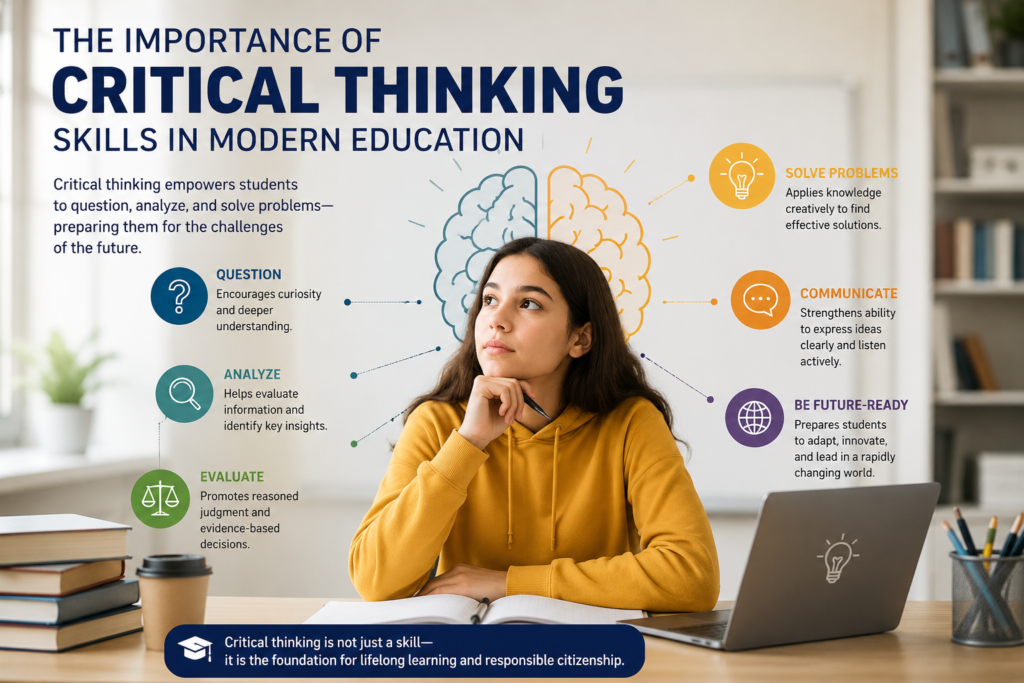
At its core, critical thinking involves several interlocking abilities:
- Analysis — Breaking an argument or problem into its components to understand the structure
- Evaluation — Judging the credibility of sources and the strength of evidence
- Inference — Drawing reasonable conclusions from incomplete information
- Explanation — Articulating how you arrived at a conclusion and why
- Self-regulation — Monitoring and correcting your own reasoning biases
None of these is instinctive. All of them require cultivation.
Why Modern Life Demands It More Than Ever
The need for critical thinking has always existed. What has changed in the past two decades is the scale and velocity of the forces working against it.
The information explosion. The internet has democratized access to information in ways that are genuinely extraordinary. It has also democratized the production of misinformation. A rumor that might once have spread through a neighborhood can now circle the globe in hours. A single misleading headline can shape the beliefs of millions before any correction is issued. The sheer volume of content competing for attention makes it difficult even for careful readers to separate signal from noise.
Algorithmic amplification. Social media platforms are designed to maximize engagement, which means they often prioritize content that provokes strong emotional responses — outrage, fear, excitement — over content that is accurate or nuanced. Users are increasingly shown information that confirms existing beliefs, creating feedback loops that harden positions and make genuine inquiry feel unnecessary or even threatening.
The rise of sophisticated persuasion. Advertising, political messaging, and propaganda have always been part of public life. But the tools available to those who wish to influence opinion have grown extraordinarily powerful. Targeted advertising, deep fakes, AI-generated text, and micro-targeting of political messages represent a qualitatively different challenge than previous generations faced. Recognizing and resisting these techniques requires a more sophisticated form of media literacy than ever before.
Complexity in the workplace. The nature of work is changing. Automation is steadily displacing routine cognitive tasks — sorting, categorizing, following scripted procedures. What remains, and what is increasingly valued, is the capacity to handle novel problems, evaluate trade-offs, communicate reasoning clearly, and adapt to new situations. These are precisely the skills that critical thinking develops.
Democratic governance. A functioning democracy depends on citizens who can evaluate policy arguments, hold institutions accountable, and recognize when they are being manipulated. This is not a partisan observation — it is a structural one. Any system of self-governance that relies on informed consent requires people who are capable of informing themselves.
Where Schools Fall Short
If critical thinking is this important, why isn’t it the central organizing purpose of formal education? The honest answer involves several overlapping failures.
Standardized testing narrows the curriculum. In many countries, the pressure to perform well on standardized tests has narrowed what teachers are able to teach. Tests that measure the recall of factual content are far easier to design, administer, and score than tests that measure reasoning quality. As a result, schools spend enormous amounts of time on content knowledge — dates, formulas, definitions — and relatively little on the processes of thinking that would allow students to do something meaningful with that content.
This is not a failure of individual teachers. Most teachers understand the value of critical thinking and would happily spend more time on it. The failure is systemic, built into accountability structures that measure the wrong things.
Passive transmission of knowledge. The dominant model of instruction in most schools remains one in which the teacher holds knowledge and transfers it to students. Students receive, record, memorize, and reproduce. This model works reasonably well for transmitting established facts. It does almost nothing to develop the capacity for independent reasoning.
A student who has spent twelve years being told what to think and what to memorize is not automatically equipped to think for themselves when they graduate. The habit of passivity, once established, is hard to break.
Avoidance of controversy. Critical thinking often requires engaging with genuinely contested questions — questions where reasonable people disagree, where evidence is incomplete, and where the stakes are real. Many schools avoid such questions altogether, either because they are politically sensitive or because they are harder to teach and assess.
The result is that students practice reasoning on toy problems — designed questions with known answers — and then encounter the actual world, which is full of genuine uncertainty, and have no framework for navigating it.
Teacher preparation. Critical thinking cannot be taught by someone who has not themselves developed the habit. Teacher education programs, particularly in countries where teaching is not a highly prestigious profession, often produce graduates who are skilled at delivering curriculum but who have had limited exposure to rigorous intellectual inquiry. Without modeling, critical thinking remains abstract.
The Evidence for Its Impact
Fortunately, there is a substantial body of research on what happens when critical thinking is deliberately taught — and the results are consistently encouraging.
Studies of interventions that explicitly teach argumentation skills — the ability to identify claims, evaluate evidence, and construct counterarguments — show measurable improvements not just in reasoning tasks, but in academic performance more broadly. Students who are taught to interrogate texts rather than merely read them retain content better and transfer their learning more effectively to new contexts.
Research on inquiry-based learning, in which students investigate authentic problems rather than receiving pre-digested answers, shows similar benefits. Students in inquiry-based classrooms demonstrate greater conceptual understanding and are better able to apply what they have learned to unfamiliar situations.
Philosophy for Children (P4C), a curriculum model developed by Matthew Lipman in the 1970s and since implemented around the world, has been evaluated in numerous studies. The evidence consistently shows that students in P4C programs improve in reading comprehension, mathematical reasoning, and social skills — gains that appear across different age groups and socioeconomic contexts.
Perhaps most importantly, the skills appear to be transferable. Critical thinking is not domain-specific in the way that, say, knowledge of organic chemistry is domain-specific. A student who has learned to evaluate evidence, identify assumptions, and reason from incomplete information can apply those habits to any field they encounter — which is precisely what you would want from a general education.
What Genuine Critical Thinking Education Looks Like
Saying that schools should teach critical thinking is easy. Describing what that actually looks like in practice is harder — and the gap between aspiration and implementation is where most reform efforts fail.
Making reasoning visible. One of the most powerful things a teacher can do is model their own reasoning process aloud. When working through a problem — whether in mathematics, literary analysis, or historical interpretation — showing the false starts, the revisions, the moments of uncertainty, demonstrates that thinking is a process rather than a performance. Students who see reasoning modeled are better equipped to develop their own.
Teaching argument structure explicitly. Students at every level benefit from explicit instruction in what an argument is. Not argument in the colloquial sense of a dispute, but in the logical sense: a set of premises offered in support of a conclusion. Learning to identify premises, evaluate whether they actually support the conclusion, and recognize common forms of fallacious reasoning gives students a concrete vocabulary for doing something they might otherwise do only intuitively and poorly.
Embracing genuine uncertainty. The best discussions in a classroom are ones where the teacher does not already know the answer — or where the answer is genuinely contested. Seminars organized around difficult texts, ethical dilemmas, or unresolved historical debates force students to do actual intellectual work rather than guess what the teacher already thinks. This requires a degree of vulnerability from teachers, and a willingness to follow a discussion wherever it leads.
Requiring students to take positions and defend them. One of the most effective ways to sharpen thinking is to require people to articulate and defend a view in the face of serious challenge. Debate, structured academic controversy, Socratic seminars, and essay assignments that require genuine argument — not summary — all force students to identify what they actually think and test whether it holds up.
Assessing reasoning, not just conclusions. This is the reform that is most difficult to implement at scale, but perhaps most important. If assessments only ask students whether their answer is correct, they provide no incentive to develop reasoning quality. Assessments that ask students to explain their reasoning, identify the weaknesses in their own argument, or evaluate a flawed argument require and reward the very capacities that critical thinking education is meant to develop.
Critical Thinking and Character
It is worth pausing on a dimension of critical thinking that is sometimes neglected in the educational literature: its relationship to intellectual character.
Technical competence in reasoning — knowing what a logical fallacy is, being able to identify when evidence is insufficient — is necessary but not sufficient. A person can know all of this and still reason dishonestly, deploying rhetorical sophistication in service of conclusions they arrived at for emotional or self-interested reasons.
Genuine critical thinking requires certain virtues: intellectual humility (the willingness to admit you might be wrong), intellectual courage (the willingness to follow reasoning to conclusions that are uncomfortable), intellectual honesty (the refusal to misrepresent evidence or dismiss inconvenient objections), and intellectual persistence (the patience to sit with a difficult problem until you actually understand it).
These are not habits that can be installed through direct instruction. They are cultivated over time, through practice and through exposure to communities that model and reward them. This has significant implications for education. It suggests that the culture of a classroom — the norms around questioning, disagreement, and intellectual risk-taking — matters as much as the formal curriculum.
A classroom in which students fear being wrong, or in which the teacher’s authority is treated as a substitute for evidence, will not produce critical thinkers regardless of how much time is formally devoted to reasoning skills. The environment must embody what it is trying to teach.
Implications for Higher Education and Beyond
The need for critical thinking does not end when formal schooling does. Universities, professional schools, and workplaces each present their own challenges — and each have their own failures.
In higher education, the lecture format still dominates in many disciplines, despite substantial evidence that active learning produces better outcomes. Students spend enormous amounts of time receiving information and relatively little time doing something with it. Seminars, writing-intensive courses, and research opportunities that require genuine inquiry exist in most universities, but they are often reserved for elite institutions or advanced students.
In professional life, the pressures of deadlines, hierarchy, and institutional inertia work against careful thinking. Organizations often reward decisiveness and speed over thoughtfulness, and punish the kind of questioning that might improve a bad decision before it is made. Building cultures that value intellectual rigor — and that create genuine space for dissent — is one of the hardest challenges in management.
In civic life, the responsibility ultimately falls on individuals. Democratic institutions cannot protect themselves; they depend on citizens who are willing to think, to question, and to resist manipulation. This is not an automatic outcome of schooling, however well designed. It requires ongoing practice and deliberate cultivation throughout adult life.
Conclusion
Critical thinking is not a skill that is nice to have. In the conditions of the early twenty-first century — information abundance, algorithmic manipulation, rapid technological change, and complex global challenges — it is a fundamental requirement for both individual flourishing and democratic health.
The education system as it currently exists is not adequately meeting this challenge. Curriculum structures, assessment practices, teaching methods, and school cultures collectively underinvest in the capacities that matter most: the ability to evaluate evidence, to construct and critique arguments, to sit with uncertainty without collapsing into either credulity or cynicism.
The good news is that these are teachable skills. The research is clear on this point. What is required is not new technology or new resources — though both may help — but a reorientation of priorities, a willingness to value the process of reasoning rather than only its outcomes, and a commitment to building the kind of intellectual culture in schools that produces students who can genuinely think for themselves.
That is, in the end, what education is for.
