Introduction
Not long ago, getting an education meant going somewhere to get it. You enrolled in a school, showed up at a fixed time, sat in a room with others, and received instruction from whoever happened to be teaching in your district, your city, or — if you were lucky enough to attend university — whichever institution admitted you. Geography was destiny. So was schedule. If your life did not fit around the class, you did not take the class.
That logic has not entirely disappeared, but it has been seriously disrupted. Online learning, once a niche offering dismissed by many as inferior to “real” education, has matured into a legitimate and in many cases superior alternative for a significant portion of what people need to learn. The growth has been driven not by any single innovation but by the convergence of faster internet access, better video technology, more sophisticated course platforms, and — perhaps most importantly — a growing body of evidence that learning does not require physical presence to be effective.
This article is not an argument that online learning is always better. It is an argument that online learning offers concrete, well-documented advantages for specific kinds of learners, specific kinds of goals, and specific kinds of circumstances — and that understanding those advantages honestly is more useful than either dismissing the medium or overselling it.
Flexibility That Changes Who Can Learn
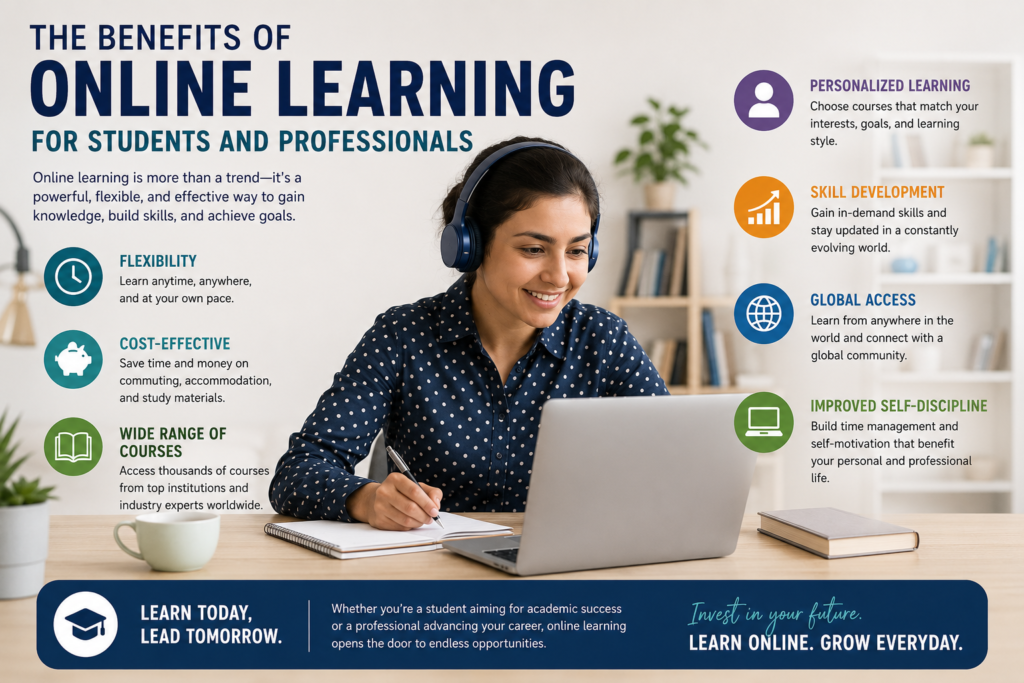
The single most significant benefit of online learning is not pedagogical. It is structural. Online education removes the requirement that learning happen at a fixed time and place, and that removal changes who can participate in education entirely.
Consider the working professional who wants to develop new skills but cannot take three hours out of a Tuesday afternoon to sit in a classroom. Consider the parent who can study only after children are in bed. Consider the person living in a rural area where the nearest community college is an hour’s drive away, or the person with a chronic illness whose capacity to leave home varies day to day. For all of these people, traditional education does not simply require inconvenience — it requires a reorganization of life that may be genuinely impossible.
Online learning makes education available to people whose lives do not fit the conventional academic schedule. This is not a minor convenience. It is a structural shift in who gets access to knowledge and credentials.
For students still in secondary school or early university, flexibility operates differently — not as a solution to adult obligations, but as an accommodation for the reality that people do not all learn at the same pace or perform best at the same time of day. A student who absorbs complex material better in the morning than in the afternoon, or who needs to re-read a difficult explanation three times before it makes sense, is no longer constrained by the pace of a group lesson that moves on after one pass.
Learning Without Geographic Limits
Before online education, the quality of learning available to any individual was largely determined by where that individual happened to live.
A student in a major metropolitan area had access to a range of institutions, instructors, and specializations. A student in a small town had access to whatever was nearby. A working professional looking to develop expertise in an emerging field needed to live near a university or company that offered training in that field, or needed to be willing to travel.
Online learning has not fully eliminated geographic inequality in education — access to reliable internet remains unevenly distributed, and the social capital that helps some learners navigate educational systems is not something any platform provides. But it has substantially widened the range of options available to people regardless of location.
A software engineer in a mid-sized city can now take a graduate-level machine learning course from faculty at a research institution on another continent. A high school student with an interest in linguistics can find structured coursework that no school within driving distance could provide. A nurse in a regional hospital can pursue a master’s degree program without relocating.
The dismantling of geography as a barrier to educational quality is one of online learning’s most consequential achievements, and its effects compound over time — particularly for people in smaller communities and developing regions where the concentration of educational expertise has historically been thin.
Cost Advantages That Are Real, Not Absolute
Online learning is frequently cheaper than in-person education, and the cost difference is real enough to matter for many learners — but it requires some precision to describe accurately.
The direct costs of online courses, certificates, and degree programs are often lower than their campus-based equivalents. Without physical facilities to maintain and with lower overhead structures, providers can offer comparable instruction at reduced tuition. Platforms offering individual courses frequently price them at a fraction of what a single university credit hour costs.
The indirect costs are where the savings become more significant. Online learners typically do not pay for housing near campus, do not commute, and do not lose work income to attend classes during business hours. For adult learners in particular, these indirect costs often exceed direct tuition — meaning the total financial burden of education can be dramatically lower when the classroom is wherever the learner happens to be.
The cost picture is not uniformly positive. Online learners sometimes pay full tuition for programs that deliver fewer services — no campus facilities, reduced advising access, fewer networking events. Free and low-cost platforms offer valuable learning, but free courses rarely come with credentials that carry weight in hiring decisions. And the cost of self-discipline — of staying enrolled and engaged without the structure of physical attendance — can be real, even if it does not show up on a tuition bill.
For the right learner in the right circumstances, the financial argument for online learning is compelling. It should not be taken as universal.
Self-Paced Learning and Mastery
One of the most persistent problems in traditional education is that it moves at the speed of the curriculum, not the speed of the learner.
A student who grasps a concept quickly is held at that concept until the class is ready to move on. A student who needs more time with a difficult topic is moved along before genuine understanding has been established. The result, across years of schooling, is students who have gaps in their knowledge that compound into larger gaps — and students who might have developed deeper expertise if they had been allowed to pursue it.
Asynchronous online learning — courses and content that learners access on their own schedule — allows a different relationship with pace. A learner who already understands statistical concepts can move through the probability section of a data science course quickly and spend more time on the modeling sections where their knowledge is thinner. A learner encountering calculus for the first time can watch an explanation as many times as needed, pause to work through problems, and return to earlier material if a later section reveals that earlier understanding was incomplete.
This is not a trivial advantage. The ability to regulate pace in response to actual understanding — rather than adhering to an externally imposed schedule — changes the nature of the learning experience. Students who struggle in traditional settings because they need more time, not more intelligence, frequently find that self-paced online learning produces better outcomes than they achieved in conventional classrooms.
For professionals developing new skills, pace flexibility has additional value. A lawyer who already understands contract law but needs to learn the specifics of intellectual property licensing can focus precisely on what is new and skip what is already familiar. The ability to customize the learning path reduces wasted time substantially.
Access to Specialized and Emerging Knowledge
No single institution can maintain faculty expertise across every field. The specializations available at any given university or training center are constrained by hiring, budget, and the critical mass of student demand required to justify maintaining a program.
Online learning breaks these constraints. A learner who wants to develop expertise in computational biology does not need to live near a university that employs computational biologists. A professional who wants to understand the regulatory landscape around autonomous vehicles can access courses from experts in that specific intersection of law and technology regardless of where those experts are located.
This matters especially in rapidly evolving fields where traditional institutions have not yet built programs. When a new technology, methodology, or professional practice emerges, the most current expertise typically lives in practitioners and researchers, not in established curricula. Online platforms can host courses from those practitioners within months of developments that would take years to enter a traditional degree program.
For professionals navigating careers in industries that are changing quickly, the ability to learn from people working at the frontier — rather than from textbooks written about practices that were current five years ago — has tangible value.
Development of Self-Direction and Discipline
Online learning is not easy in the ways that matter most. The absence of physical structure — of a classroom you must travel to, a seat you must fill, a teacher whose presence creates social accountability — means that learners must supply their own discipline and motivation.
This is frequently cited as a disadvantage of online learning, and for some learners it is. Completion rates for free online courses are notoriously low. Many people begin courses with genuine intention and drift away when competing demands accumulate and no external structure holds them accountable.
But for learners who succeed in online environments, the development of self-direction is itself a valuable outcome. Managing a learning schedule alongside work and other obligations, maintaining engagement with material without external accountability, and completing projects without a teacher checking in regularly are skills that transfer directly to professional life.
The professionals who consistently upgrade their knowledge, stay current in their fields, and pursue learning as a continuous practice tend to be the same people who are comfortable learning without being supervised. Online learning both requires and develops this capacity. For students who are preparing for professional careers, the development of self-directed learning habits is not incidental to the coursework — it may be as valuable as the content itself.
A Broader Range of Learning Formats
Text on a page and lecture in a classroom are not the only ways people learn. Some people understand concepts most readily through visual diagrams. Some retain information better through practice problems than through reading. Some benefit from hearing a concept explained conversationally rather than formally. Some need to pause and reflect between pieces of information rather than receiving it in a continuous stream.
Traditional classroom instruction can accommodate some of this variation, but not much. A teacher with thirty students and fifty minutes will teach in a way that reaches the most students — which is not the same as the way that reaches all students.
Online learning environments, when well designed, offer content in multiple formats. A single concept might be presented through a short video explanation, an interactive diagram, a worked example, a practice problem set, and a written summary. A learner who did not understand the video can try the diagram. A learner who found the written explanation confusing can watch the video. The redundancy that would be wasteful in a classroom becomes a resource in an asynchronous environment.
Discussion forums, peer review assignments, collaborative projects conducted through shared documents, and live video sessions with instructors all provide social dimensions to online learning that early iterations of the medium lacked. The idea that online learning is necessarily a solitary activity has become less accurate as platforms have developed richer interaction tools.
Career Advancement Without Career Interruption
For working professionals, one of the most practical benefits of online learning is the ability to develop new skills and earn new credentials without leaving the workforce.
The traditional model for significant career development — go back to school, earn a degree, return to work — involves a period of income loss and career interruption that is not feasible for everyone. Depending on family obligations, financial situations, and career trajectories, a two-year break from professional life can carry costs that outweigh the benefits of the credentials gained.
Online degree programs, certificate programs, and professional development courses allow professionals to continue working while building the qualifications for their next career step. A marketing professional who wants to move into data analytics can take evening and weekend courses in statistics and machine learning without abandoning current employment. A manager who wants to qualify for senior leadership roles can pursue a graduate business degree incrementally over several years.
This incremental model of professional development is not for everyone — it requires sustained commitment over long periods, and the slow pace can be frustrating for people eager to make a change quickly. But for learners with significant professional and personal obligations, the ability to advance without interruption is not a compromise. It is the only viable option.
Continuous Learning as a Professional Requirement
The expectation that a professional’s education concludes with a degree is increasingly outdated. In most fields, the body of relevant knowledge continues to expand throughout a career. New tools emerge. Research overturns established practices. Regulations change. Markets shift. The professional who is not learning is, in a meaningful sense, falling behind.
Online learning is particularly well suited to this reality of continuous professional development because of its accessibility on short timescales. A professional who needs to understand a new technology does not need to enroll in a semester-long course — they can find a focused module, workshop, or video series that addresses precisely what they need to know, at a time when they need to know it.
This just-in-time approach to learning — acquiring knowledge at the point of need rather than in advance of need — is more efficient than traditional front-loaded education for many professional applications. It reduces the time between learning something and using it, which also tends to improve retention.
Organizations have recognized this shift. Corporate training and professional development have moved substantially online, and the ability to deploy updated training to distributed workforces simultaneously, without logistics costs, has made online learning a standard operating practice in many industries.
Environmental and Logistical Considerations
The environmental dimension of online learning is less frequently discussed but worth noting.
Campus-based education requires physical infrastructure — buildings that must be heated and cooled, grounds that require maintenance, transportation networks that carry students and faculty to and from campus. The carbon footprint of a traditional educational institution is substantial, and a significant portion of it is tied to commuting and campus operation.
Online learning reduces, though does not eliminate, this footprint. Learners who study at home rather than commuting to campus save not only time and money but fuel. Institutions that deliver instruction online require less physical space and the associated resources to maintain it.
For large-scale professional training programs serving hundreds or thousands of employees across multiple locations, the logistical savings of online delivery are significant. The alternative — transporting employees to training centers, booking facilities, scheduling sessions — involves coordination costs that online delivery eliminates.
Where Online Learning Still Struggles
Honesty requires acknowledging that online learning is not a superior solution in all circumstances, and that some of its limitations are structural rather than temporary.
Subjects that require physical presence — clinical practice in medicine and nursing, hands-on work in the trades, laboratory science, performance in music and theater — cannot be fully replaced by digital instruction. The knowledge components of these fields can often be taught effectively online, but the practice components require being in a room with real equipment, real patients, real instruments, or real collaborators.
The social experience of traditional education — the relationships formed through shared physical space, the mentors who notice a student’s potential and shape their direction, the informal conversations that happen between classes — is not replicated by even the most social online environment. For younger students in particular, school is not only a place to acquire knowledge but a place to develop socially, and that function cannot be abstracted into a digital platform.
Learner motivation and persistence remain significant challenges. Without the external accountability of physical attendance, many learners struggle to maintain commitment. Completion rates for online courses, especially free ones, are substantially lower than for in-person equivalents. This is partly a selection effect — people who casually enroll in a free course have less at stake than students who paid tuition and showed up on the first day — but it reflects a real structural challenge.
Conclusion
The case for online learning is not that it is better than in-person education. It is that for a large and growing portion of what people need to learn, it is at least as good, often more accessible, frequently more affordable, and sometimes the only viable option.
The student in a small city who wants specialized instruction unavailable locally, the professional who cannot interrupt a career to return to campus, the parent who can only study between ten at night and midnight, the person with a disability that makes regular campus attendance difficult — for all of these learners, online education is not a second-best option. It is the path that makes learning possible at all.
The medium continues to improve. Platforms are more capable than they were five years ago, and will be more capable still in another five. The evidence base for what works in online instruction is growing. The stigma that once attached to degrees and credentials earned online has largely faded in professional hiring, as employers have come to recognize that the learning matters more than the format in which it was delivered.
What has not changed, and is unlikely to change, is the fundamental requirement: that the learner bring genuine commitment, a clear purpose, and the willingness to do the actual work. Online learning has removed many of the barriers that once stood between people and education. It cannot remove the one that was always most important.
