
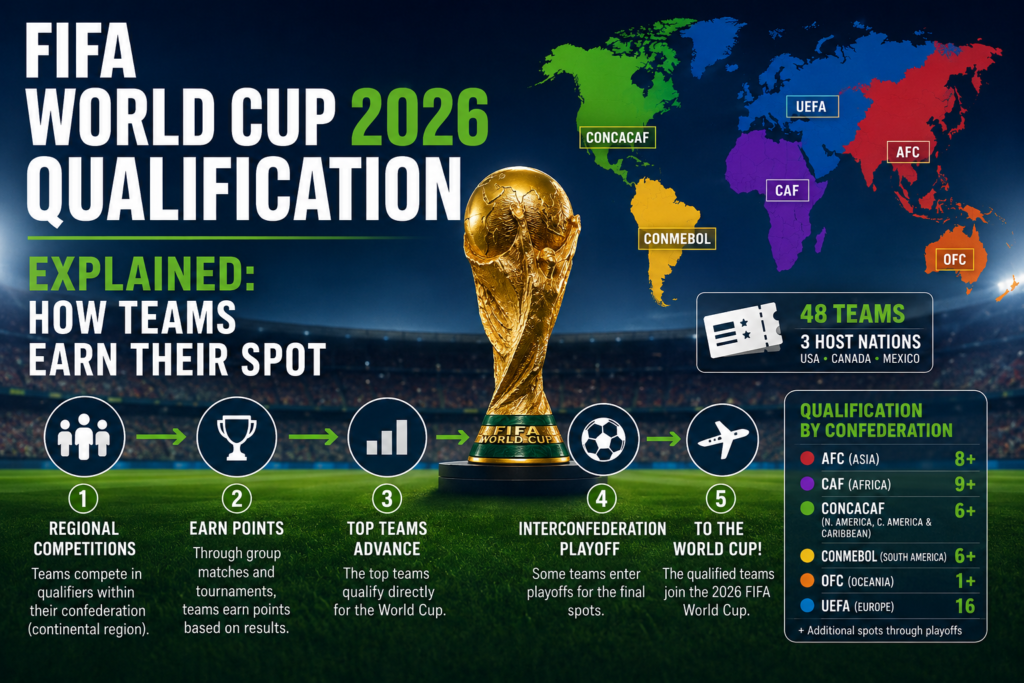
The FIFA World Cup is the dream stage for every football nation. However, before teams can compete for the biggest prize in football, they must first survive a long and challenging qualification process. With the FIFA World Cup 2026 expanding from 32 teams to 48 teams, more countries than ever have the opportunity to qualify and make history.
This guide explains how the FIFA World Cup 2026 qualification system works and how teams earn their place in the tournament.
A New Era for the FIFA World Cup
The 2026 FIFA World Cup is the first edition to feature 48 teams. The tournament is hosted by the United States, Canada, and Mexico, making it the first World Cup to be organized by three countries.
Because the host nations automatically qualify, the remaining spots are filled through continental qualification tournaments organized by FIFA’s six confederations.
The expansion from 32 to 48 teams means more nations can participate, creating greater competition and excitement around the world.
How Many Teams Qualify?
A total of 48 teams compete in the FIFA World Cup 2026.
Automatic Qualification
The three host countries automatically qualify:
- United States
- Canada
- Mexico
These nations do not need to participate in qualification matches.
Qualification Spots by Confederation
FIFA distributes World Cup places among six football confederations:
AFC (Asia)
- 8 direct qualification spots
- 1 additional intercontinental playoff spot
Countries such as Japan, South Korea, Australia, Saudi Arabia, Iran, and others compete for qualification.
CAF (Africa)
- 9 direct qualification spots
- 1 playoff opportunity
African nations compete in a highly competitive qualification campaign where every point matters.
CONCACAF (North, Central America, and Caribbean)
- 3 automatic spots reserved for the host nations
- Additional qualification places available for other regional teams
Countries like Costa Rica, Jamaica, Panama, and Honduras fight for World Cup participation.
CONMEBOL (South America)
- 6 direct qualification spots
- 1 intercontinental playoff spot
Traditional football powers such as Brazil, Argentina, Uruguay, Colombia, and Ecuador compete in one of the toughest qualification systems in the world.
OFC (Oceania)
- 1 direct qualification spot
- 1 playoff opportunity
This is historic because Oceania receives a guaranteed World Cup place for the first time.
UEFA (Europe)
- 16 direct qualification spots
Europe receives the largest number of World Cup places due to the strength and depth of its national teams.
What Are Intercontinental Playoffs?
Not every qualification spot is awarded directly. Some teams must enter an intercontinental playoff tournament.
In this stage, teams from different confederations compete against one another for the final World Cup positions.
These playoff matches often produce dramatic moments because a single game can determine whether a nation reaches the World Cup.
Why Qualification Is So Difficult
Many football fans focus on the World Cup itself, but qualification can be just as challenging.
National teams often play qualification matches over several years. They must travel long distances, perform consistently, and compete against strong regional rivals.
Even famous football nations sometimes struggle to qualify. History has shown that previous champions and major football powers are not guaranteed a place in the tournament.
Biggest Qualification Surprises
World Cup qualification regularly produces unexpected results.
Some smaller nations achieve historic qualifications for the first time, while established teams occasionally miss out.
These surprises are one reason why qualification campaigns attract so much attention from football fans around the globe.
Benefits of the 48-Team Format
The expanded tournament offers several advantages:
More Nations Participate
Additional qualification spots allow more countries to experience the World Cup.
Increased Global Representation
Teams from Africa, Asia, Oceania, and North America have better opportunities to compete on football’s biggest stage.
More Competitive Football
The expanded format creates new rivalries and gives emerging football nations a chance to prove themselves.
Greater Fan Engagement
Supporters from more countries can follow their national teams throughout the tournament.
What Happens After Qualification?
Once all qualification campaigns are completed, FIFA conducts the World Cup draw.
Qualified teams are placed into groups, and the tournament schedule is finalized. From there, the focus shifts from qualification to the race for football’s most prestigious trophy.
Conclusion
The FIFA World Cup 2026 qualification process is the gateway to football’s greatest tournament. With 48 teams participating for the first time, more nations have a realistic chance of reaching the World Cup and making history.
From regional qualifiers to intercontinental playoffs, every match plays a crucial role in determining which teams will compete on the global stage. For players, coaches, and fans, qualification is the first step toward achieving World Cup glory.
