
Introduction
Every generation believes it is living through a particularly consequential period of change. Most are right to some degree. But the pace at which the economy is restructuring around technical knowledge — the speed at which entire job categories are being transformed, created, or rendered obsolete — is not business as usual. It is something qualitatively different, and the education systems that were designed for a slower-moving world are struggling to keep pace with it.
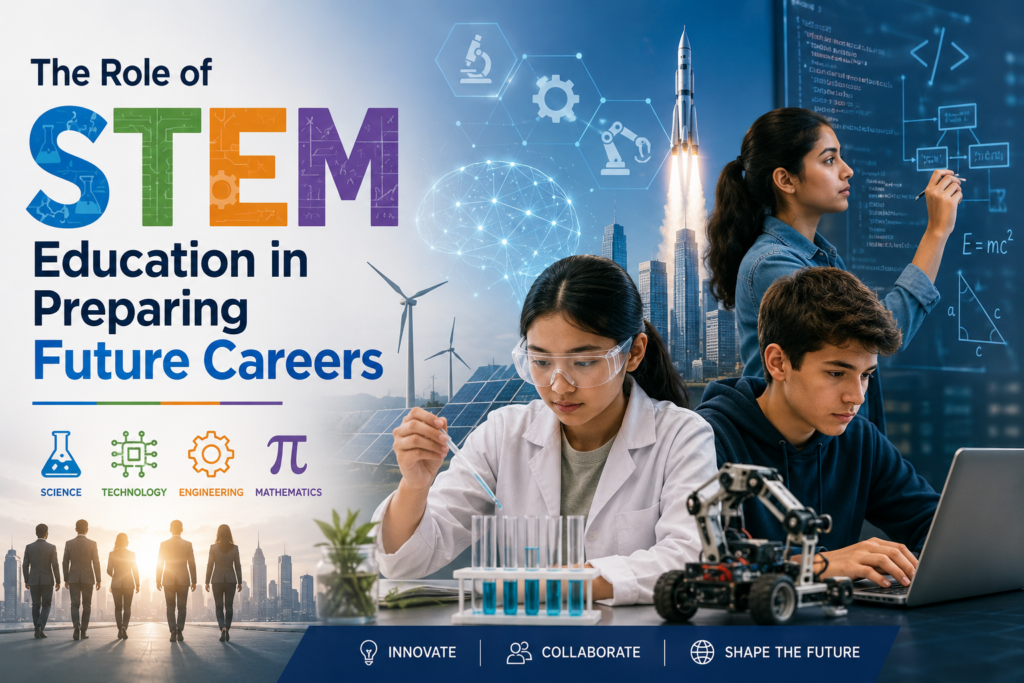
STEM education — the deliberate integration of science, technology, engineering, and mathematics into the curriculum from the earliest grades through postgraduate study — has become the primary institutional response to this restructuring. It is not the only response that matters, and it is not without its critics and complications. But the argument that technical fluency is no longer the exclusive domain of scientists and engineers, that it is becoming a baseline requirement for meaningful participation in the modern economy, is difficult to dispute.
This article examines what STEM education actually is in practice, what it prepares students to do, what it tends to neglect, and why its role in shaping career outcomes across nearly every sector has become central to both educational policy and individual planning.
What STEM Education Actually Means
The acronym is simple. What it represents in practice is more varied, and the gap between the idea and its implementation deserves attention before the benefits can be honestly assessed.
At its best, STEM education is not simply more science and math classes. It is an approach to learning that emphasizes inquiry over memorization, problem-solving over recitation, and the integration of disciplines over the isolated study of subjects that never speak to each other. A well-designed STEM curriculum asks students to work on problems that do not have predetermined answers, to collect and interpret real data, to build things that either work or do not work, and to understand why.
This approach reflects how work actually happens in technical fields. An engineer does not sit alone applying formulas from a textbook. She works in teams, communicates findings to non-specialists, navigates constraints imposed by budgets and regulations and material properties, and iterates when the first solution fails. A biologist does not simply know biological facts — he designs experiments, analyzes results statistically, interprets ambiguous data, and revises hypotheses. STEM education, at its most effective, prepares students for this reality rather than for the performance of reproducing correct answers on standardized assessments.
At its worst, STEM education is simply a relabeling exercise — existing courses in math and science decorated with new branding, taught in the same way as before, producing the same outcomes. The distinction matters because much of what has been claimed as STEM education in policy documents and funding proposals describes the aspiration rather than the reality. Evaluating what STEM education can do requires being honest about the difference.
The Labor Market Has Already Changed
To understand why STEM education has become a priority rather than a preference, it helps to look at what has actually happened in the labor market over the past two decades.
The jobs that have grown most substantially in availability and compensation are concentrated in fields that require quantitative reasoning, data literacy, computational thinking, or engineering knowledge. Software development, data science, biomedical research, renewable energy systems, cybersecurity, financial analysis, logistics optimization, and advanced manufacturing have all expanded significantly. In each of these fields, the shortage of qualified workers is not a temporary gap — it reflects a structural mismatch between the skills being developed through conventional education and the skills that employers need.
The jobs that have contracted most are those involving routine tasks that follow predictable patterns — data entry, basic accounting, repetitive assembly work, standard clerical processing. These are not jobs that disappeared because of economic downturns. They contracted because automation made it possible to perform those tasks without human labor, and automation is overwhelmingly a product of advances in engineering and computer science.
This is not the entire story. Healthcare, education, social work, and other sectors involving complex human interaction have grown substantially and are not primarily STEM fields. The narrative that STEM is the only pathway to career security overstates the case. But the pattern is clear enough: technical fluency has become a significant determinant of career trajectory in a way that it was not for previous generations, and the trend is continuing rather than reversing.
STEM Skills Across Industries That Seem Unrelated
One of the more important developments in the conversation about STEM education is the recognition that technical skills are not confined to obviously technical careers.
Agriculture has been transformed by precision farming — the use of sensors, satellite data, drones, and analytical software to optimize irrigation, pest management, and yield prediction. The farmer who understands this technology is more productive and more competitive than one who does not. This is not a job that appears in the “STEM careers” brochure, but it now has significant STEM content.
Healthcare delivery has been reshaped by electronic health records, diagnostic imaging software, genomic medicine, and data-driven treatment protocols. Nurses, physical therapists, and healthcare administrators who can work fluently with quantitative data and digital tools are more effective and more employable than those who cannot. The STEM content of clinical work has increased substantially even for roles that are not research positions.
Journalism has developed a subfield of data journalism — the use of statistical analysis and data visualization to investigate and explain complex stories. Reporters who can analyze large datasets, identify patterns, and present them visually have access to stories that purely narrative reporters cannot tell. This is a technical skill set applied in a field traditionally associated with writing and communication.
Even fields like law and finance, which have long required analytical rigor, have been transformed by the availability of large datasets, algorithmic tools, and computational methods that reward practitioners who understand them. The lawyer who understands how machine learning systems work is better positioned to argue cases involving them. The financial analyst who can build and interpret quantitative models has capabilities that analysts without that background lack.
STEM education, in this broader view, is not preparation for a narrow set of careers. It is preparation for the technical dimensions that have entered nearly every career.
Early STEM Education and Why It Matters
The research on when STEM interest and ability develop points consistently to the importance of early exposure — not just in terms of what children learn, but in terms of what they come to believe about themselves.
Children who have positive experiences with science, mathematics, and hands-on problem-solving in elementary school develop a relationship with those subjects that influences whether they continue to engage with them as they advance through school. The child who learns in fifth grade that she is capable of understanding how forces work, who builds a simple circuit and sees it light up, who measures the growth rate of plants under different conditions and draws conclusions from her own data — that child carries a different sense of her own capacity than one who has only encountered science as a set of facts to memorize and math as a set of procedures to replicate.
This matters because the pipeline problem in STEM fields — the persistent shortage of qualified people entering technical careers — begins not in university, where remediation is difficult and late, but in elementary and middle school, where foundational dispositions are formed. Students who conclude early that they are “not a math person” or that science is for people with a particular kind of mind tend not to reverse that conclusion later. They close off pathways before they have genuinely explored them.
Early STEM education, done well, keeps those pathways open. It introduces children to ways of thinking — measuring, hypothesizing, testing, revising — before they have formed fixed beliefs about what kinds of minds are suited for technical work. It builds the foundational skills in numeracy and logical reasoning that make more advanced learning possible. And it signals, by the seriousness with which schools treat these subjects from the beginning, that technical knowledge is a legitimate and valued pursuit.
Computational Thinking: The New Baseline
Among the specific competencies that STEM education develops, computational thinking has attracted particular attention — and for reasons that extend well beyond the specific skill of writing code.
Computational thinking refers to a set of cognitive approaches that include breaking complex problems into smaller components, identifying patterns and regularities, abstracting away irrelevant details to focus on essential structure, and designing step-by-step procedures that can be followed to solve a problem reliably. These are the fundamental moves of programming, but they are also useful in contexts that have nothing to do with computers.
A student who has learned to think computationally approaches a biology lab report differently — identifying the core question, stripping away noise, designing a procedure that tests the key variable, interpreting results systematically. A student who has learned to decompose complex problems finds that long essay questions in history or economics become more tractable when broken into their constituent parts. The cognitive habits developed through programming and algorithmic thinking transfer to other domains in ways that educators have begun to document.
At the same time, the specific skill of understanding how software and digital systems work has become broadly relevant simply because those systems are now embedded in nearly every professional environment. Understanding how data is stored, how search algorithms work, how automated systems make decisions, and how digital security can be compromised or protected is not knowledge reserved for technology professionals. It is knowledge that allows anyone to participate more intelligently in the digital systems that shape their professional life.
Engineering Thinking and Real-World Problem Solving
The engineering component of STEM education is sometimes treated as a delivery mechanism for technical knowledge — a way to make math and science more engaging by embedding them in projects. But engineering thinking, as a distinctive approach to problems, has value that goes beyond its role as a pedagogical vehicle.
Engineering is defined by constraints. An engineer does not simply solve a problem in the abstract — she solves a problem given limited materials, limited budget, limited time, and specifications that may themselves be in tension. A bridge must be strong enough, light enough, cheap enough, and safe enough simultaneously. These requirements pull against each other, and the engineer’s work is to find solutions that satisfy all constraints sufficiently rather than any single one perfectly.
This constrained problem-solving approach is exactly what professional life requires in almost every field. A public health official designing a vaccination campaign must satisfy constraints of cost, logistics, community trust, and timeline. A product manager developing software must balance user needs, technical feasibility, and resource limits. A teacher designing a curriculum works within constraints of time, assessment requirements, student readiness, and available materials.
Students who have worked through engineering design challenges — who have built something, tested it, watched it fail, diagnosed why, and revised their approach — have practiced a cognitive skill that is genuinely transferable. They have learned that failure is diagnostic rather than terminal, that iteration is the process rather than evidence of inadequacy, and that solutions to complex problems are found through systematic refinement rather than sudden inspiration.
The Critical Role of Mathematics
Of the four components of STEM, mathematics carries a particular weight. It is both a subject in its own right and the language in which the other subjects are expressed. A student who cannot reason quantitatively cannot fully engage with statistics, chemistry, physics, computer science, or economics. The mathematical foundation is not optional.
This creates an urgency around mathematics education that is not always matched by its execution. Mathematics is the subject in which gaps compound most severely — where a misunderstanding in one year creates confusion in the next, where students who fall behind rarely catch up without specific intervention, and where the cultural message that some people simply are not mathematical does the most damage.
Research on mathematics education has clarified several things that effective instruction requires. Students need to understand why procedures work, not only how to execute them. They need to develop number sense — an intuitive feel for quantity and relationship — not just procedural fluency. They need opportunities to reason about mathematical problems rather than only practice solving them in prescribed ways. And they need teachers who themselves have deep mathematical understanding, which is not something that can be assumed.
The consequences of mathematical weakness extend well beyond STEM careers specifically. Quantitative literacy — the ability to interpret statistics, evaluate risk, understand proportions and rates, and reason about numerical claims — is necessary for informed decision-making in everyday life. The citizen who cannot evaluate a statistical claim is more vulnerable to misinformation. The worker who cannot interpret a performance metric is less able to advocate for themselves or contribute to organizational decisions. Mathematics education is, at its best, an investment in the capacity for reasoned judgment across all domains.
STEM and the Diversity Problem
Any honest discussion of STEM education must grapple with its persistent diversity problem. Women, students from lower-income backgrounds, and students from several racial and ethnic groups are underrepresented in STEM fields at every level from university enrollment through senior professional positions. This is not a new observation, and it is not improving as rapidly as the attention paid to it might suggest.
The causes are multiple and interact in ways that make simple solutions inadequate. Stereotype threat — the anxiety produced by awareness of negative stereotypes about one’s group’s performance in a subject — measurably reduces performance on mathematical tasks. The absence of visible role models in technical fields shapes what students consider possible for themselves. Differential quality of early mathematics education means that students from under-resourced schools arrive at secondary school with gaps that constrain their options. Implicit bias in how teachers evaluate student ability affects which students receive encouragement to pursue technical coursework.
These are not small effects, and they accumulate over time. A student who received slightly less encouragement in fifth grade mathematics, who had fewer role models suggesting technical careers were available to her, and who attended a secondary school with a weaker science program has substantially different career options at twenty-two than a student without those disadvantages — even if their raw ability was identical.
Addressing the diversity problem in STEM is not merely a matter of equity, though it is certainly that. It is also a matter of economic capacity. A society that draws its technical talent from a fraction of the population available is developing less capability than it could. The untapped STEM potential that currently goes undeveloped because of structural barriers represents a genuine loss.
The Soft Skills That STEM Education Also Develops
A persistent criticism of STEM education is that it narrows focus at the expense of communication, creativity, collaboration, and the humanities. The criticism contains truth — poorly designed STEM programs can produce technically capable graduates who struggle to write clearly, think ethically about the implications of their work, or communicate findings to non-specialists.
But the criticism often underestimates what good STEM education actually develops. The student who has worked through a multi-week engineering project in a team has practiced collaboration, conflict resolution, and the negotiation of competing ideas. The student who has presented a science fair project to judges who asked hard questions has practiced public communication under pressure. The student who has written a lab report that must explain methodology, results, and interpretation clearly has practiced the precision and organization that technical writing requires.
Beyond these process skills, STEM education at its best also develops habits of mind that transfer broadly: comfort with uncertainty, willingness to revise beliefs in response to evidence, the ability to distinguish between what is known and what is assumed, and the recognition that complex questions rarely have simple answers. These are not exclusively scientific virtues — they are intellectual virtues with wide application.
The addition of Arts to the STEM acronym — producing STEAM — reflects the recognition that creative and aesthetic thinking is not separate from technical work but integrated with it. The most influential engineers and scientists are rarely those with the most technical knowledge alone. They are people who bring creative imagination to technical problems and technical rigor to creative ideas.
What Employers Are Actually Looking For
The conversation about STEM education sometimes proceeds as though employers have a simple list of technical skills they need and education systems must provide them. The reality, as employers describe it, is more complicated.
Employers consistently report that technical knowledge is necessary but insufficient. The candidate who can write code but cannot explain what problem their code solves, cannot identify when a project has gone in the wrong direction, and cannot adapt when requirements change is less valuable than the candidate who combines technical ability with communication, judgment, and adaptability.
Project management, the ability to prioritize competing demands, skill at working across disciplinary boundaries, and willingness to engage with ambiguous problems are among the competencies most frequently cited by employers as difficult to find in STEM graduates. These are not soft skills in the dismissive sense of the term — they are capabilities that require deliberate development and that determine whether technical knowledge can be applied effectively in real organizational contexts.
The implication for STEM education is that technical training alone is not sufficient preparation for professional life. The curriculum must also create conditions in which students practice working on complex, open-ended projects; collaborate across roles; communicate with diverse audiences; and engage with the ethical dimensions of their technical decisions.
STEM Education Beyond the Classroom
Schools are not the only place where STEM learning happens, and for many students they are not even the primary place where meaningful technical engagement occurs.
Science and engineering competitions — robotics tournaments, coding competitions, mathematics olympiads, science fairs — provide opportunities for deep engagement with technical challenges in competitive settings that motivate some students far more effectively than regular coursework. The culture of these competitions, with their emphasis on iteration, collaboration, and creative problem-solving, often better reflects professional technical culture than does conventional classroom instruction.
Internships, apprenticeships, and research experiences place students in real professional environments where they can observe and participate in actual technical work. The student who spends a summer in a research laboratory, a software company, or an engineering firm learns things about professional technical work that cannot be taught in a classroom — including the unglamorous realities of scientific research, the collaborative nature of software development, and the constraints that govern engineering decisions in practice.
After-school programs, maker spaces, coding clubs, and community workshops extend STEM engagement to students who may not be well served by formal school programs — including students in under-resourced schools where the formal STEM curriculum is weaker, and students whose particular learning styles are better matched to hands-on building and experimentation than to conventional instruction.
The ecosystem of STEM learning is broader than the school curriculum, and policies and investments that strengthen the whole ecosystem — not only classroom instruction — are more likely to produce the outcomes that justify the emphasis on STEM education.
Preparing for Careers That Do Not Yet Exist
One of the arguments made most frequently in favor of STEM education is that it prepares students for jobs that do not yet exist. This claim is sometimes presented as straightforwardly true, and it is — but it requires careful interpretation.
No educational program can directly prepare students for roles that have not been defined. The specific technical skills required for jobs in 2040 cannot be taught in 2025 because those jobs have not been invented and the technologies they involve are not yet mature.
What STEM education can do is develop the foundational capabilities — mathematical reasoning, scientific thinking, computational fluency, systematic problem-solving — that allow people to acquire new specific skills throughout their careers. A person who understands mathematics deeply can learn a new quantitative framework more quickly than one who does not. A person who understands how software is built can learn a new programming language more easily than one who has never thought computationally. A person who is comfortable with ambiguity and practiced at revising their understanding in response to new information can adapt to a changing technical landscape more readily than one who learned a fixed set of procedures.
This adaptability — the capacity to continue learning effectively throughout a career — is perhaps the most valuable outcome of strong STEM education, and it is the quality most directly relevant to a labor market that will continue to change in ways that are genuinely unpredictable.
Conclusion
STEM education is not a magic solution to the challenges of preparing students for a rapidly changing economy. No educational reform is. Schools are part of a larger social system, and the outcomes of education are determined by factors — income inequality, access to healthcare and nutrition, family stability, community resources — that schools cannot control.
But within the domain of what education can influence, the case for rigorous, well-designed STEM education is strong. The economy continues to reward technical fluency, and the rewards for that fluency extend across industries and roles far beyond what the label “STEM careers” traditionally implies. The cognitive habits developed through scientific reasoning, mathematical thinking, and engineering problem-solving — habits of evidence, precision, iteration, and systematic inquiry — are among the most transferable intellectual tools available.
The student who emerges from twelve years of schooling with genuine quantitative literacy, comfort with data and evidence, some experience with computational thinking, and the ability to approach novel problems systematically is better prepared for professional life — and for the ongoing demands of learning throughout that life — than one who does not have those capacities, regardless of the specific career they pursue.
Getting STEM education right requires honesty about where it currently falls short: in equity of access, in the quality of teacher preparation, in the tendency to prioritize testable content over genuine inquiry, and in the neglect of the communication and ethical reasoning that technical work also requires. Acknowledging those gaps is not an argument against the enterprise. It is the beginning of taking it seriously enough to do it well.
