
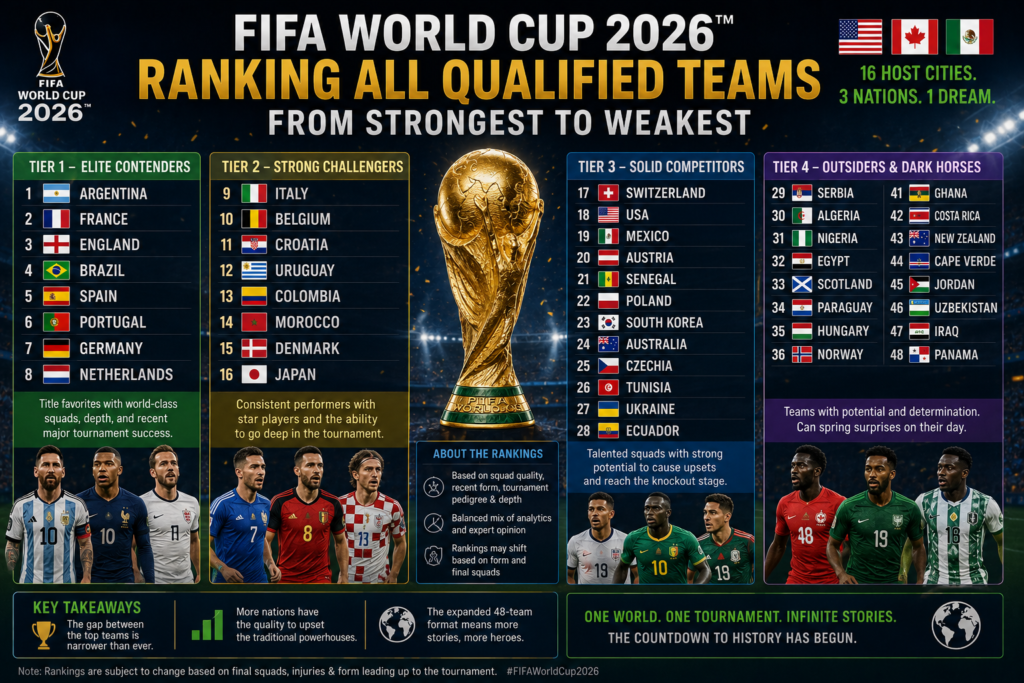
The FIFA World Cup 2026 is set to be the biggest tournament in football history. With 48 qualified teams competing across the United States, Canada, and Mexico, fans can expect thrilling matches, unexpected upsets, and fierce competition for football’s greatest prize.
While every nation has earned its place through qualification, not every team enters the tournament with the same expectations. Some are genuine title contenders, while others will simply hope to make history by reaching the knockout stage.
Based on recent international performances, squad quality, tactical strength, depth, and tournament experience, here is a complete ranking of the qualified teams from strongest to weakest.
Tier 1: The Top Title Favorites
These nations have everything needed to lift the FIFA World Cup trophy.
1. Argentina
The defending champions remain one of the strongest teams in world football. Argentina combines experience, tactical discipline, squad chemistry, and attacking quality. Their winning mentality makes them one of the favorites once again.
Strengths
- Championship experience
- Strong midfield
- Excellent teamwork
- Reliable goal scorers
2. France
France possesses incredible depth in every position. Their blend of youth and experience makes them one of the most balanced squads in the tournament.
Strengths
- Elite attacking talent
- Fast counterattacks
- Deep squad
- Tournament experience
3. Spain
Spain continues to impress with technical football and a talented young generation. Their possession-based style allows them to dominate many matches.
Strengths
- Ball control
- Creative midfield
- Tactical flexibility
- Emerging young stars
4. Brazil
Brazil always enters the World Cup among the favorites. Their attacking flair, individual brilliance, and football tradition make them dangerous opponents.
Strengths
- Creative attackers
- Fast wingers
- Strong squad depth
- Winning history
5. England
England has one of the most talented squads in international football. If they remain consistent in knockout matches, they can challenge for the title.
Strengths
- Powerful attack
- Balanced midfield
- Physical defense
- Excellent squad depth
Tier 2: Serious Championship Contenders
These teams have realistic ambitions of reaching the semi-finals or even the final.
6. Portugal
Portugal combines experienced leaders with exciting young talents. Their attacking quality makes them dangerous against any opponent.
7. Germany
Germany has rebuilt into a disciplined and competitive side capable of making another deep World Cup run.
8. Netherlands
The Dutch remain one of Europe’s strongest tactical teams with excellent defensive organization.
9. Italy
Italy’s tactical discipline and defensive structure always make them difficult to eliminate in tournament football.
10. Belgium
Although entering a new generation, Belgium still possesses plenty of attacking quality.
Tier 3: Strong Quarter-Final Candidates
These nations have enough talent to surprise tournament favorites.
11. Croatia
Tournament experience and intelligent midfield play continue to make Croatia a difficult opponent.
12. Uruguay
Uruguay combines traditional fighting spirit with emerging young talent.
13. Morocco
One of the strongest defensive teams in international football, Morocco has already shown it can defeat elite opponents.
14. Denmark
Disciplined, organized, and tactically intelligent, Denmark consistently performs well in major tournaments.
15. Switzerland
Switzerland’s defensive structure makes them dangerous in knockout football.
Tier 4: Dangerous Dark Horses
These teams have the quality to reach the Round of 16 or beyond.
- Japan
- Mexico
- United States
- Senegal
- Serbia
- Austria
- Poland
- South Korea
- Czech Republic
- Sweden
Each possesses talented players and enough quality to produce major upsets.
Tier 5: Competitive Knockout Hopefuls
These teams may not be title favorites, but they can compete strongly in the group stage.
- Canada
- Wales
- Norway
- Scotland
- Turkey
- Nigeria
- Egypt
- Algeria
- Ecuador
- Colombia
- Peru
- Paraguay
A favorable draw could see several of these nations reach the knockout rounds.
Tier 6: Teams Looking to Surprise
These nations are capable of earning memorable victories.
- Australia
- Tunisia
- Cameroon
- Ghana
- Costa Rica
- Panama
- Jamaica
- Honduras
- Venezuela
- Chile
While they may not be among the favorites, World Cups often produce unexpected success stories.
Tier 7: Tournament Underdogs
Every World Cup includes teams whose primary objective is gaining experience and competing against the world’s best.
Possible underdogs include:
- New Zealand
- Uzbekistan
- Jordan
- Iraq
- South Africa
- Bolivia
- El Salvador
- Curaçao
- Oman
- Guatemala
- Angola
- Mali
- DR Congo
For these nations, even reaching the knockout stage would represent a historic achievement.
Factors That Could Change the Rankings
Pre-tournament rankings are only predictions. Several factors can dramatically change a team’s chances.
Injuries
Losing a key player can weaken even the strongest squad.
Team Chemistry
Well-organized teams often outperform squads filled with individual stars.
Home Support
The United States, Canada, and Mexico may benefit from passionate home crowds.
Tactical Flexibility
Managers who adapt quickly during matches often outperform expectations.
Momentum
Teams that start the tournament strongly usually gain confidence as the competition progresses.
Potential Surprise Teams
Several nations could exceed expectations during FIFA World Cup 2026.
- Morocco
- Japan
- United States
- Senegal
- Norway
- Canada
These teams possess talented squads capable of upsetting traditional football giants.
Why Rankings Don’t Always Predict Champions
History has shown that the strongest team on paper does not always lift the trophy.
World Cups are decided by:
- Confidence
- Teamwork
- Tactical discipline
- Fitness
- Mental strength
- A little bit of luck
Unexpected heroes emerge in every tournament, making football the world’s most unpredictable sport.
Final Thoughts
The FIFA World Cup 2026 promises to be one of the most competitive tournaments in football history. Traditional powerhouses like Argentina, France, Spain, Brazil, and England enter as the leading favorites, but history reminds us that surprises are part of every World Cup.
With an expanded 48-team format, more nations than ever have the opportunity to make history. Dark horses such as Morocco, Japan, the United States, and Senegal could challenge the established giants, while emerging teams will look to announce themselves on football’s biggest stage. Regardless of the pre-tournament rankings, the true strength of every nation will be decided where it matters most—on the pitch.
