
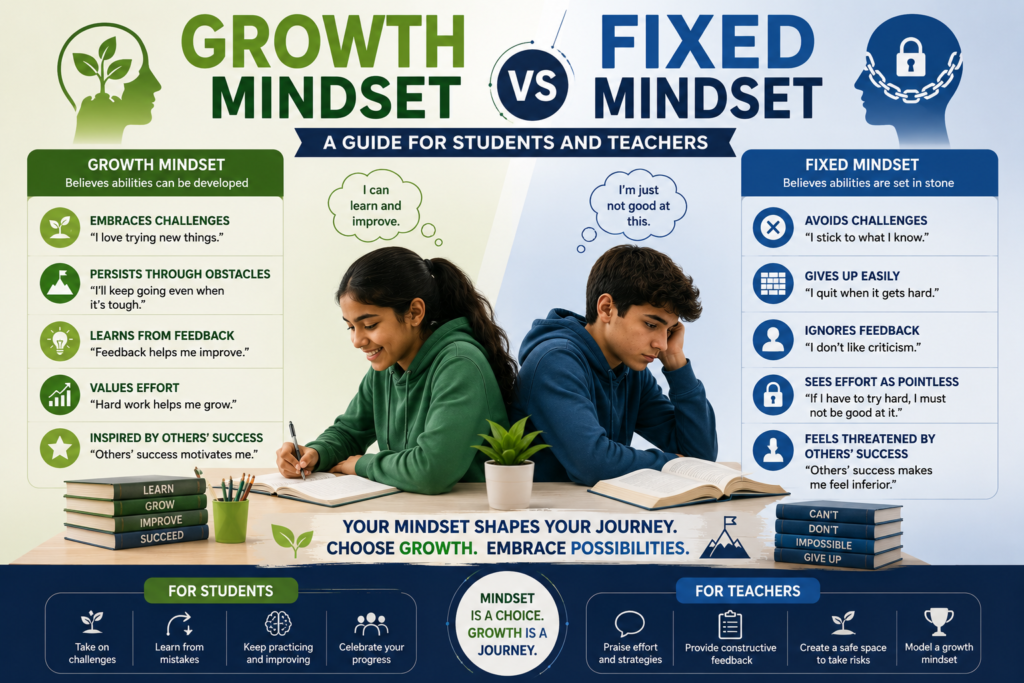
Success in education is influenced not only by intelligence and talent but also by the way people think about learning. The concept of mindset has gained significant attention in education because it shapes how students approach challenges, setbacks, and opportunities for growth. Understanding the difference between a growth mindset and a fixed mindset can help both students and teachers create a more positive and effective learning environment.
What Is a Growth Mindset?
A growth mindset is the belief that abilities, intelligence, and skills can be developed through effort, practice, and learning. Students with a growth mindset understand that success is not determined by natural talent alone. Instead, they see challenges as opportunities to improve and mistakes as valuable learning experiences.
For example, when faced with a difficult math problem, a student with a growth mindset may think, “I don’t understand this yet, but I can learn it with practice.” This attitude encourages persistence and continuous improvement.
What Is a Fixed Mindset?
A fixed mindset is the belief that intelligence and abilities are permanent traits that cannot be significantly changed. Students with a fixed mindset often believe that they are either naturally good or bad at certain subjects.
When encountering a challenge, they may feel discouraged and give up quickly. A student with a fixed mindset might say, “I’m just not good at math,” rather than looking for ways to improve. This perspective can limit learning and reduce motivation.
Key Differences Between Growth and Fixed Mindsets
The two mindsets influence how students respond to learning experiences.
Growth Mindset
- Embraces challenges.
- Learns from mistakes.
- Values effort and persistence.
- Seeks feedback for improvement.
- Believes skills can be developed over time.
- Views success as the result of hard work and learning.
Fixed Mindset
- Avoids difficult tasks.
- Fears failure and criticism.
- Gives up easily when facing obstacles.
- Sees effort as a sign of weakness.
- Believes abilities are unchangeable.
- Often compares personal abilities with others.
These differences can have a significant impact on academic achievement and personal development.
How a Growth Mindset Benefits Students
Students who adopt a growth mindset are more likely to stay motivated and resilient when facing academic challenges. Instead of seeing failure as proof of inability, they view it as part of the learning process.
A growth mindset can help students:
- Improve academic performance.
- Build confidence and self-esteem.
- Develop stronger problem-solving skills.
- Become more independent learners.
- Handle setbacks more effectively.
- Maintain a positive attitude toward learning.
These benefits contribute not only to success in school but also to future personal and professional achievements.
The Role of Teachers in Developing a Growth Mindset
Teachers play a crucial role in shaping students’ attitudes toward learning. The language educators use can influence how students view their abilities and potential.
Teachers can encourage a growth mindset by:
- Praising effort rather than natural talent.
- Encouraging students to learn from mistakes.
- Providing constructive feedback.
- Setting challenging but achievable goals.
- Creating a classroom culture that values progress and improvement.
- Teaching students that intelligence can develop through practice and experience.
When teachers focus on growth and learning, students become more willing to take risks and embrace challenges.
Strategies for Students to Build a Growth Mindset
Developing a growth mindset requires consistent practice. Students can strengthen this way of thinking by adopting simple habits.
Some effective strategies include:
- Replacing negative thoughts with positive learning-focused statements.
- Setting realistic goals and tracking progress.
- Viewing mistakes as opportunities to learn.
- Seeking help when needed.
- Celebrating improvement rather than perfection.
- Practicing patience and persistence.
Over time, these habits can transform the way students approach learning and achievement.
Creating a Positive Learning Environment
A supportive environment is essential for developing a growth mindset. Schools, teachers, and parents should work together to encourage curiosity, effort, and resilience.
When students feel safe to ask questions, make mistakes, and try new things, they are more likely to develop confidence in their ability to learn and grow. This positive atmosphere fosters both academic success and personal development.
Conclusion
The difference between a growth mindset and a fixed mindset can greatly influence a student’s educational journey. While a fixed mindset may limit potential, a growth mindset encourages resilience, continuous learning, and self-improvement. By embracing challenges, learning from mistakes, and valuing effort, students can unlock their full potential. Teachers also play a vital role by creating classrooms that support growth and inspire lifelong learning. Together, students and educators can build a culture where success is defined not by natural ability but by dedication, perseverance, and a willingness to learn.
